People and Contractor Control
Identity, booking reference and authorisation checked at the barrier, tied into the site's own visitor registration, pass issue and induction process.


Telford's employment areas were laid out as large planned estates, so most sites here are controlled at a defined gate rather than at a shopfront.
AGS Security supplies SIA-licensed security guards across Telford's manufacturing plants, engineering works, distribution units, infrastructure compounds, live construction plots, business parks, empty units, shops, offices and public buildings. Each assignment is specified against that site's own gate arrangements, shift pattern and duties rather than a borough-wide template.
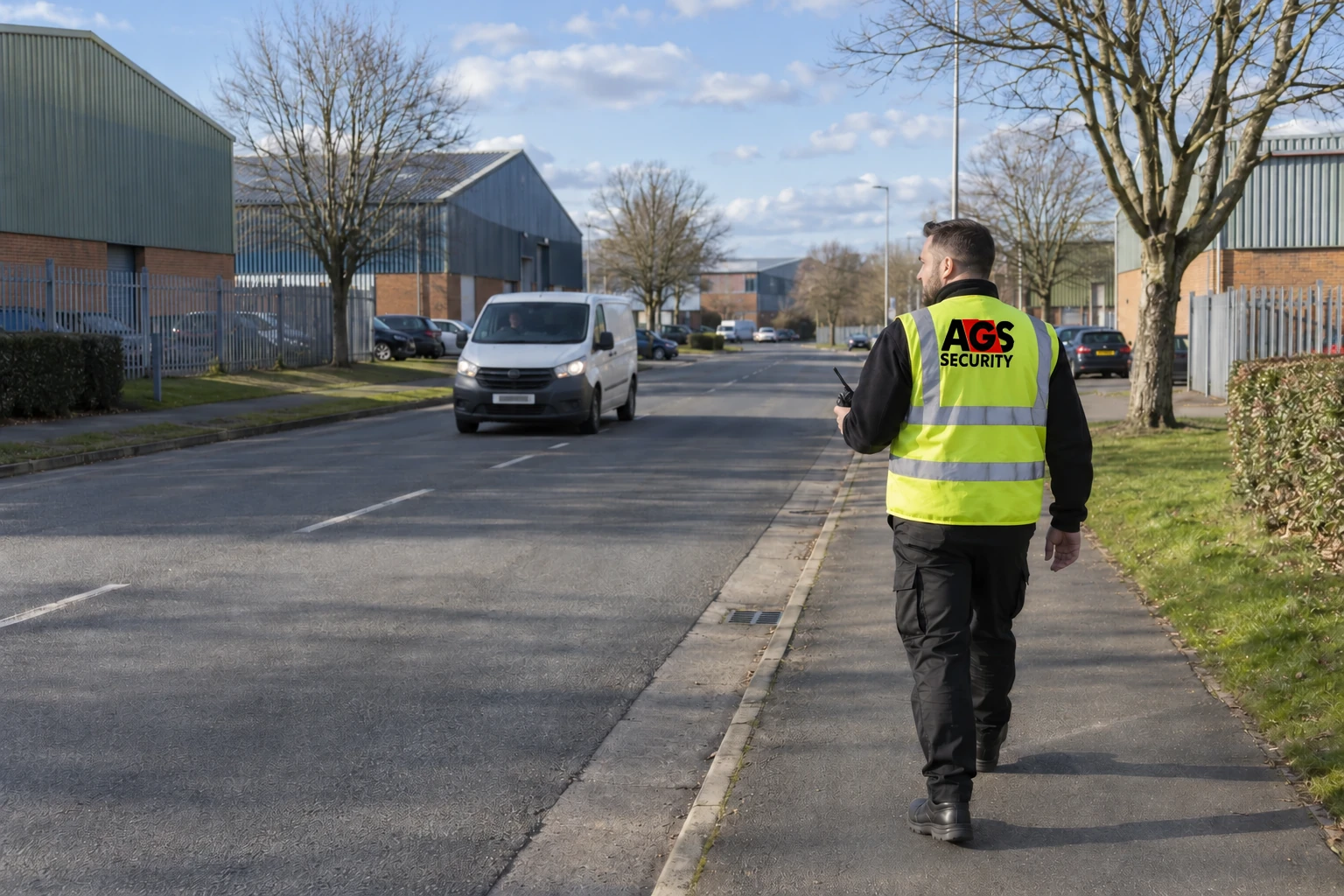
On the estates at Hortonwood, Halesfield and Stafford Park the working day is dominated by vehicles: booking drivers in, matching loads to paperwork, keeping waiting HGVs off the estate road, and walking boundaries that can run several hundred metres behind a single unit. In the town centre, at Southwater and in Wellington, the same officer role shifts towards people — visitors, staff arriving and leaving, and premises that stay open to the public.
Guarding can run continuously or cover a defined window: a plant shutdown, a build programme, a fit-out, the gap between tenants, or a period when a site is running short-staffed. What decides the arrangement is what is actually exposed and who is accountable for it.
Written assignment instructions, reporting requirements and named escalation contacts are agreed before the first shift, so the client, the officer and the AGS supervisor are all working to the same document.

The schemes and bodies AGS Security is accredited by, registered with or a member of. If your procurement process needs certificates or scheme numbers, ask and we will provide the relevant documents.







Telford is a major manufacturing and employment centre with strong engineering, automotive, defence, electronics, plastics, food production, logistics, construction, digital and business-service activity.
Manufacturing and engineering have an unusually important role in the local economy. Telford's production base includes automotive supply-chain businesses, defence engineering, high-technology electronics, plastics and other specialist manufacturers, supported by established industrial estates and development land close to the M54.
Logistics and distribution are also important. The M54, A5 and A442 connect industrial locations across Telford and Wrekin, while facilities around Donnington add rail-freight context. Warehouses, production sites and trade premises therefore manage regular HGV arrivals, loading areas, external storage, drivers, agency staff and contractors.
The town continues to develop through commercial expansion, housing, education, transport and town-centre projects. Telford Town Centre, Southwater, Station Quarter, Wellington and Oakengates create a different mix of offices, retail, education, leisure and public-facing premises.
These environments do not create one standard security requirement. A factory running shifts needs different access, patrol and shutdown arrangements from a warehouse managing timed deliveries. A power or infrastructure compound may require controlled access and perimeter procedures, while a construction site changes throughout the programme. A shop, office or public building needs an officer who can work appropriately around staff, visitors and the public.
The sections below explain how those requirements differ in practice and which AGS security services may apply.
A borough-wide crime total is context, not a risk assessment for an individual premises. What matters for a Telford site is which offences reach commercial property, and how often they end without anyone being identified.
Burglary of business and other non-residential property is the category that bears most directly on the sites across Telford’s estates, and a borough-wide trend in it, up or down, still combines different places, times and premises. It does not tell a factory manager whether a yard has vulnerable access points, a warehouse operator whether trailers or external stock are exposed, or a developer whether plant and materials will be targeted.
National outcome data helps explain why security is usually specified before a loss rather than after one. Across England and Wales in the year to March 2026, 83.2% of vehicle offences were closed with no suspect identified. For a business, deterrence, access control and documented site procedures can be more realistic protections than assuming property will be recovered after it has left the premises.
Security should be matched to the site, operating pattern and any known incident history. One Telford business may need a visible guard, a controlled entrance and a documented patrol plan. Another may need mobile patrols, key holding and alarm response outside normal hours. A general-purpose patrol dog team may be considered for an appropriate higher-risk open site where the assessment and operating environment justify it.
Data sources: the outcome rate is from the Home Office year-ending March 2026 outcomes data. The plant-theft figure is from the Home Office Equipment Theft (Prevention) Act economic note, based on a 2016 estimate restated at 2025/26 prices. Both are national figures, labelled as such, and are not Telford-specific. Recorded-crime figures are context, not a prediction of risk at an individual premises.
Telford was built around production, and its estates still carry a dense concentration of factories, engineering works and supply-chain plants — which puts factory security at the centre of the local requirement rather than at the edge of it.
Automotive components, defence engineering, electronics, plastics, metal fabrication, production equipment and food processing all operate here, frequently on single-occupier plots with their own gate, yard and weighbridge. Shift changes push large numbers of people through one entrance in a short window, alongside agency workers, contractors and booked deliveries.
That concentration at the gate is where factory security starts. An officer can run the site's own employee, visitor, contractor and delivery procedures, hold the records the site needs, and stop exceptions at the barrier without backing traffic up onto the estate road or holding up production.
What needs protecting is rarely just the building. Tooling, non-ferrous metal, components, finished stock, fuel and external storage all sit inside the boundary, and on a deep Telford plot much of it cannot be seen from the gate at all. Patrol routes are set to reach goods doors, yards, tank and bunker areas, outbuildings and the long rear boundaries the estate layout creates. Shutdowns and holiday closures need their own plan, because the site empties of people while the plant and stock stay exactly where they were.


Telford's position on the M54, with access to the A5, A442 and wider motorway network, supports warehouses, distribution premises and manufacturing supply chains across the borough.
Industrial areas at Hortonwood, Halesfield, Stafford Park, Hadley Park and Donnington accommodate a mix of factories, warehouses, trade premises and distribution operations. The rail-freight facilities at Donnington add another logistics dimension to the area.
The job is to control access without slowing the operation down. Drivers arrive across extended hours, agency staff and contractors change regularly, and goods-in and goods-out create several separate points where people, vehicles and stock cross the boundary in opposite directions.
A permanent gate officer suits a distribution site with steady HGV movements. Smaller warehouses, several units on the same estate, or premises that only become exposed after closing may be better served by mobile patrols, key holding and alarm response. The specification should follow vehicle volumes, loading schedules, yard layout, trailer standing, stock value, external storage and operating hours.
On Telford's larger plots the gatehouse is not one control among several — it is usually the only position from which the site can see everything that enters.
Estate roads here are wide and quick, plots are deep, and many units run staff and freight through a single controlled entrance. That concentrates identification, authorisation, load checking and record-keeping into one position, and AGS gatehouse officers run it to the client's written access procedure.
Identity, booking reference and authorisation checked at the barrier, tied into the site's own visitor registration, pass issue and induction process.
Bookings matched to loads, paperwork checked, drivers directed to the right bay, and vehicles held or refused where the written instruction says they should be.
A defensible record of who was on site and when, with a documented incident trail supporting the client's own management, safety and escalation arrangements.
Because Telford's estates were master-planned, the space between the units is as much of a security problem as the units themselves.
Estate roads, shared parking, service yards, verges, landscaped margins and external storage often belong to no single occupier's security arrangement — and neither do the unlet units sitting between two trading businesses. An estate-wide plan can put scheduled foot and vehicle patrols, timed guarding, checks on the vulnerable units, key holding for several premises and one alarm-response route under a single instruction instead of six.
Hortonwood, Halesfield, Stafford Park, Hadley Park, Donnington and T54 each behave differently — age of stock, unit size, how much open ground sits behind the buildings, and how easily an estate road can be driven into after dark. Patrol frequency, route, access authority and reporting should come from a walk of the actual estate, not from its size or postcode.
Estate roads, parking, service yards, unit frontages, rear boundaries and the open ground Telford's layouts leave between plots.
One agreed key and response procedure covering several premises for a landlord, managing agent or group of occupiers.
Documented visits or guarding for unlet units, buildings between tenants and premises waiting on fit-out works.
Explore Commercial Property and Business Park Security | Explore Mobile Security Patrols
AGS Security has provided security officers and security dog handlers at a power station near Telford.
Utilities, substations, engineering compounds and infrastructure projects can combine high-value assets, specialist contractors, controlled work areas and changing boundaries. Security arrangements may be required during construction, installation, commissioning, maintenance or a period when an operational site has reduced staffing.
The duties must be defined around the actual project. They can include controlled access, contractor and vehicle checks, patrols of compounds and perimeters, protection of assets and materials, incident reporting, and escalation under the client's instructions. General-purpose patrol dog teams may be considered where the assessed risk and site conditions justify them.
Development in Telford and Wrekin runs on two tracks at once: new employment land out on the estates, and regeneration inside the older town centres.
Station Quarter has brought education, business and residential activity next to Telford Central, while smaller regeneration and improvement schemes affect Wellington, Oakengates and the established employment areas. Industrial expansion continues at Hortonwood, with further allocated employment land at T54 and Ni.PARK at Newport. On the corridor itself, the M54-to-M6 link road moved from survey and detailed design into preparatory works during 2026, with construction still ahead of it rather than complete.
These named projects and locations describe Telford's development environment. They do not imply that AGS protects any scheme, contractor, occupier or organisation mentioned.
A site rarely needs the same cover from first fence to handover. Groundworks and enabling leave a large open plot with plant standing out overnight. The main build brings deliveries and a contractor population that changes week to week. Fit-out puts expensive equipment inside a structure whose doors and alarms are not yet live. Handover leaves finished, empty units standing alongside a still-working site.
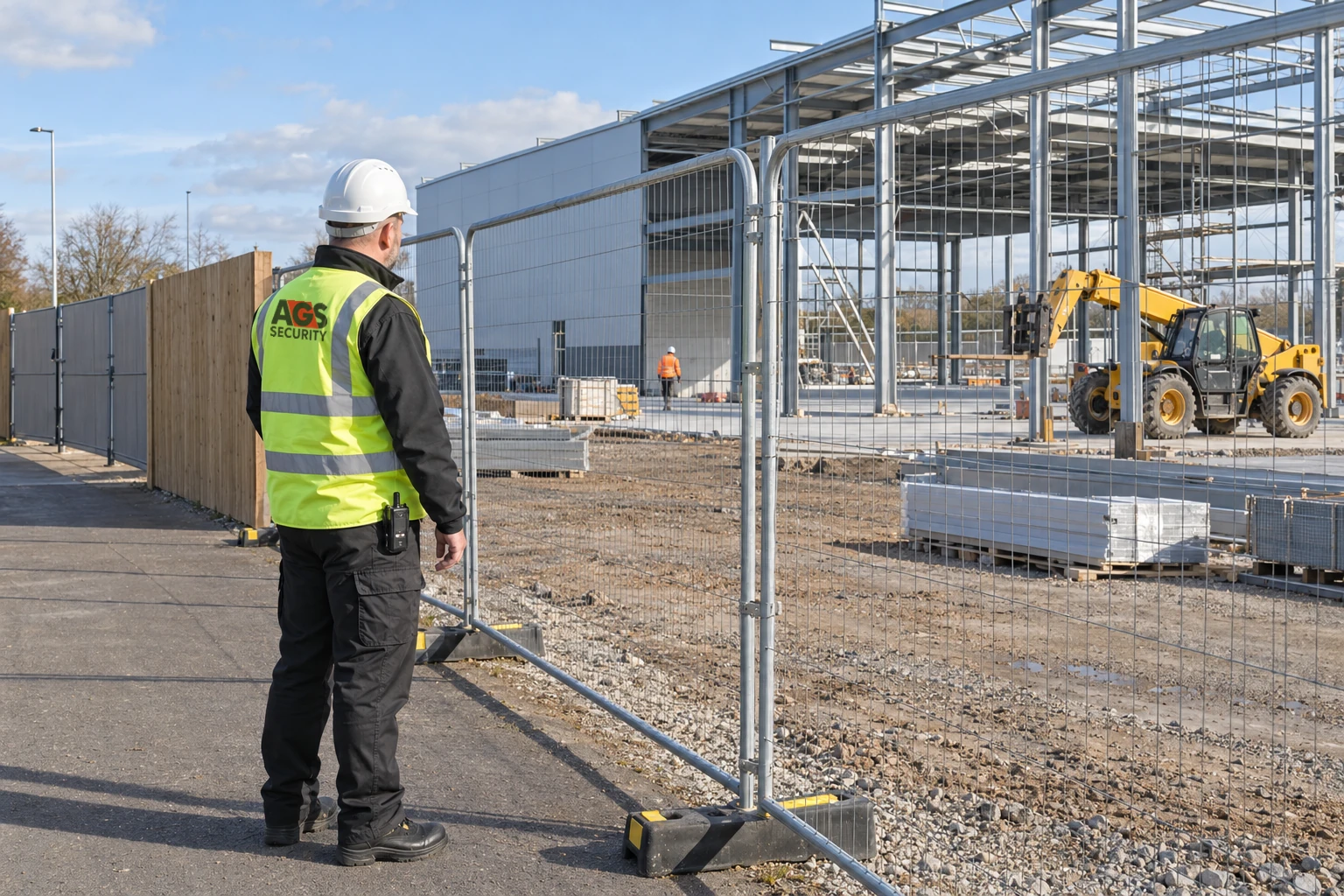
A Telford unit can pass through every one of these states within a few years, and each carries a different exposure and a different person responsible for it.
An empty unit on a live estate: documented patrols, key holding and response, stepped up to guarding where the building's exposure justifies it.
Temporary boundaries, contractors arriving from several different firms, and plant left standing on open ground overnight.
Gate control and delivery management while expensive equipment moves into a shell whose doors and alarms are not yet live.
The role turns from protecting a site into running a front door: reception, visitor management, opening and closing, key holding.
Settled occupancy, where guarding, patrol and response are trimmed back to the hours the building is genuinely exposed.
Most losses happen in the handover between one stage and the next, when nobody is certain whose security arrangement is still running.
Telford's retail splits between a large covered centre and the separate town centres at Wellington, Oakengates and Newport — and the security job is not the same in each.
In the covered centre, at Southwater and at The Forge, a store officer works alongside managed common areas, shared service corridors and a car park the retailer does not control. In the older town centres the shop fronts directly onto the street and manages its own entrance, back door and closing routine. Duties are set to match: entrance and exit cover, shop-floor presence, support for staff during incidents, observation of higher-risk areas, opening and closing, and incident records kept to the retailer's policy. Where several units are involved, store cover can be combined with mobile patrols, key holding and alarm response for car parks, service yards and back-of-house doors.
Explore Retail Security Guards | Explore Retail Sector Security
Telford Town Centre, Station Quarter and the borough's education, health and civic buildings put officers in front of the public, where the job has to be done without making the building feel closed.
Front-of-house officers can manage visitors, contractors, passes and deliveries. Telford's office stock is largely low-rise and estate-based, so external doors, service areas and car parks matter as much as the lobby once the building empties.
Access control, visitor procedures, reception support, patrols and incident reporting, delivered around clinical and care routines rather than across them. Security officers do not replace clinical, care or statutory safeguarding roles.
Reception security, visitor and contractor control, patrols, and opening and closing support, following the premises' own safeguarding procedures. Holiday periods and building works are when these sites are most often left exposed.
Hotels, conference venues and leisure premises may need guarding, reception support, access control, internal and external patrols, key holding or out-of-hours protection. Late licensing and event nights change the requirement, so duties should reflect actual operating hours and the venue's own procedures.

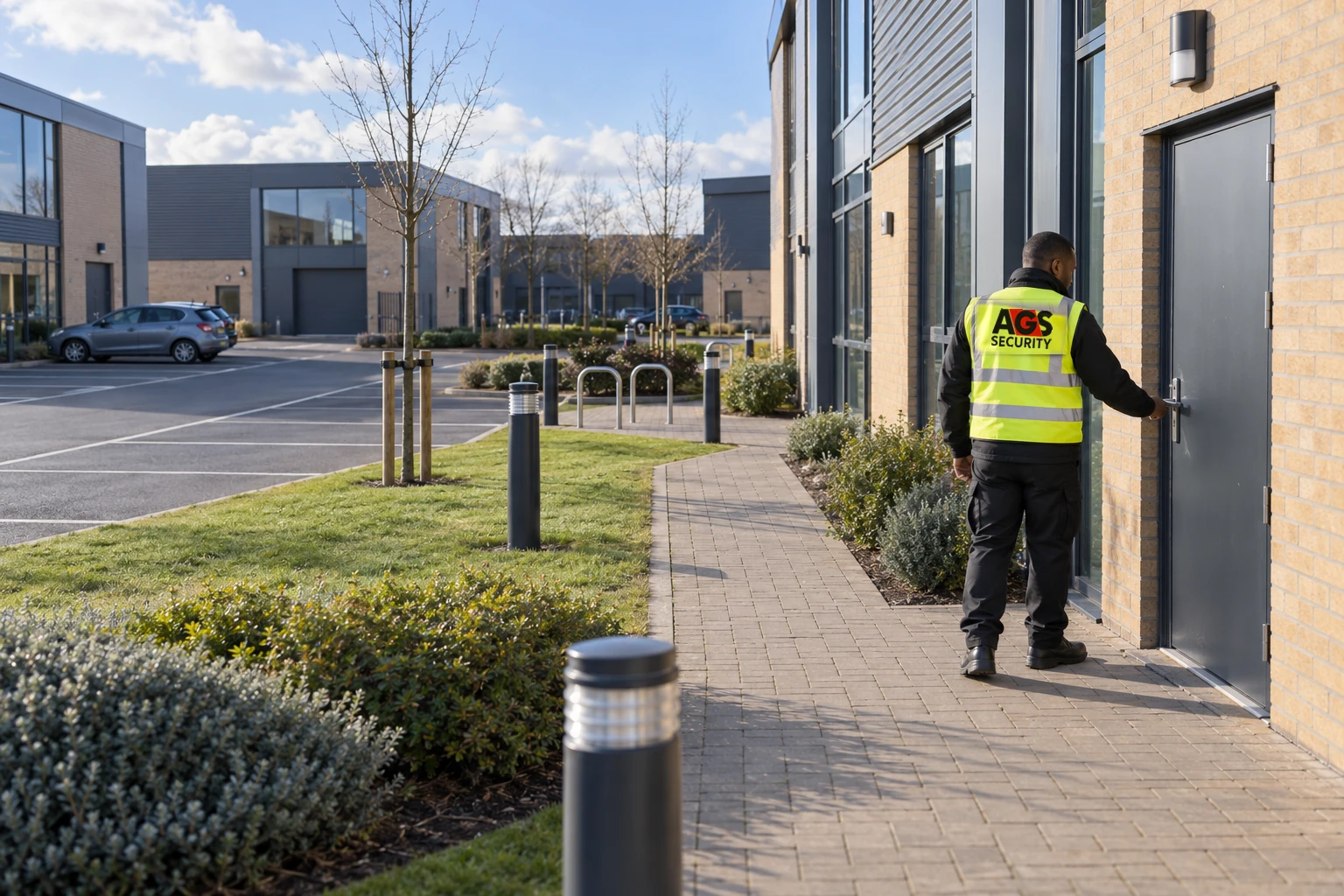
Telford's commercial stock turns over: units are relet, operations consolidate, and buildings stand empty between one occupier and the next.
An empty building fails differently from an occupied one. A forced door may not be found for days, fixtures and metals can be stripped out, yards and access land attract fly-tipping, and a water or fire problem can run unnoticed between visits. Large single-occupier units of the kind Telford has a lot of are particularly exposed, because nothing overlooks them once the estate goes quiet. Insurers frequently attach inspection and record-keeping conditions to empty premises, which the owner or manager should confirm directly with the insurer.
Depending on the building and the assessed risk, vacant property security in Telford can run from scheduled mobile patrols with documented checks, key holding and alarm response through to manned guarding on site, with CCTV-supported arrangements where they add something. Where remote monitoring is required, it is delivered through an accredited third-party monitoring centre.
Most Telford requirements combine two or three of these — a gate position with patrol cover, or guarding with key holding for the hours the site is shut.
Telford's commercial geography extends from a central business, retail and leisure area to large industrial estates, logistics locations and local centres across the borough.
These locations and transport corridors describe Telford's economy and geography. They do not imply that AGS Security supplies any named development, business, occupier or organisation.
AGS can assess requirements anywhere in Telford and Wrekin, subject to the service, hours, duties and operational requirement.
AGS Security is a Wolverhampton-based security company covering Telford, Telford and Wrekin, Shropshire and the wider West Midlands region, with its head office sitting on the same M54 corridor that serves Telford's estates.
For anyone comparing security companies in Telford, the useful question is not how long the service list is. It is whether the proposed arrangement matches the actual gate, the actual hours and the actual duties.
That starts with the site itself: access points, operating and shift hours, what is worth taking, how contractors and visitors move through, any incident history, and what the client needs recorded. Officers are briefed against written duties, with supervision and an agreed escalation route behind them.
AGS has also worked locally: it has supplied security officers and security dog handlers at a power station near Telford. That sits alongside wider construction, industrial, logistics, commercial and vacant-property experience, and it is offered as evidence rather than as an implied relationship with any named local employer.
Common questions from Telford facilities teams, property managers, site managers and business owners.
Yes. AGS provides SIA-licensed security guards and manned guarding across Telford — factories and engineering works on the estates, warehouses and distribution units, infrastructure compounds, live construction plots, business parks, empty units, shops, offices and public buildings. Duties and hours are set for the individual site before the first shift.
Yes. AGS Security is headquartered in Wolverhampton and provides commercial security services in Telford and the wider Telford and Wrekin area. Coverage is confirmed against the required location, hours, duties and start date.
Yes. On a Telford production site that usually means a gate position running the employee, contractor and delivery procedures, patrols reaching the goods doors, yards and rear boundaries a deep plot creates, and a separate arrangement for shutdowns and holiday closures. Key holding and alarm response can sit alongside it.
Yes. Cover can take in the entrance, driver and delivery procedures, the yard, loading bays, trailer standing and the boundaries that back onto open estate ground. A permanent gate officer suits a site with steady HGV movements; a smaller unit, or one that is only exposed after closing, may be better served by patrols, key holding and alarm response.
Yes. Gatehouse officers check driver, vehicle, visitor, contractor and delivery information against the client's access procedure, keep the presence record, direct vehicles to the correct bay, and record incidents or anything refused at the barrier.
Yes. AGS has supplied SIA-licensed security officers and security dog handlers at a power station near Telford, working through a third-party contract for a cable and energy systems manufacturer. The role covered controlled access, contractor and vehicle checks, patrols of compounds and perimeters, and protection of high-value equipment and materials. The client and the site are not named.
Yes, and it is a core area of AGS's work. AGS provides manned guarding and gatehouse cover to a national housebuilder across multiple live residential developments, from groundworks through to final handover. In Telford, cover can include security guards, access and delivery control, contractor procedures, hoarding and perimeter checks, patrols, protection of plant and materials, and general-purpose patrol dog teams where the assessed risk justifies them. The housebuilding experience described is national and no engagement on any named Telford project is implied.
Yes. On estates such as Hortonwood, Halesfield or Stafford Park, one plan can cover the estate roads, parking, service areas, boundaries and any vacant units, using scheduled patrols, timed guarding, key holding across several premises and a single alarm-response route.
Yes. Patrols can cover external areas, access points, boundaries and agreed internal locations, which on an estate often means several units in one visit. Frequency, timing, access authority and reporting are set for the site.
Yes, subject to the location and agreed arrangement. AGS can hold keys securely, attend alarm activations, check the premises, record findings and escalate under the agreed instructions. Availability and arrangements are confirmed for the individual site.
Yes. Retail officers can give a visible shop-floor presence, cover entrances and exits, support staff through incidents, assist with opening and closing, and record incidents to the retailer's procedure. A unit inside the covered centre and a shop fronting the street in Wellington or Oakengates are different specifications, so duties are agreed per store.
Yes. AGS has provided vacant property cover on a large empty warehouse site, working through a national vacant property specialist. For a Telford unit, cover can run from scheduled mobile patrols with documented checks, key holding and alarm response through to guarding on site, with CCTV-supported arrangements where they add something. Property owners should confirm any inspection conditions with their insurer.
CCTV-supported arrangements can form part of a wider security plan. Where remote monitoring is required, it is delivered through an accredited third-party monitoring centre; AGS does not claim to employ its own monitoring operators.
Yes. Evenings, nights, weekends, plant shutdowns and holiday closures are all normal patterns on Telford's industrial sites. The achievable start date and cover pattern depend on the location, duties, officer profile and resource availability.
AGS can assess requirements across Telford Town Centre, Stafford Park, Hortonwood, Halesfield, Hadley, Donnington, Wellington, Oakengates, Madeley, Dawley, Ketley, Lawley, Ironbridge, Newport and other nearby locations.
Pricing depends on the hours and days covered, number of officers, duties, site layout, risk, contract duration and whether guarding is combined with gatehouse, dog handling, patrol, key holding or response services. A public-facing town-centre premises is a different specification from a factory at Hortonwood or a multi-unit estate at Stafford Park, so AGS quotes against the written requirement rather than publishing an arbitrary hourly rate.
Send the site address, type of premises, proposed start date, required hours, expected officer duties and any known access, patrol, incident or reporting requirements. A site plan, photographs or a short visit help where the boundary is long, there is more than one gate, or vehicle movements are complicated.
Send the site address, the hours you need covered and what the officer is expected to do. AGS will assess the requirement and quote for security services in Telford against that specification rather than a standard rate card.
Request Telford Security Cover