
Civil Engineering Site Security: Why Infrastructure Projects Are Hardest to Protect
Infrastructure work does not sit behind a fence. It runs for miles, changes shape weekly, and carries the one commodity organised theft wants most. This civil engineering site security briefing examines the exposure, the law, recent enforcement, and the model that suits a linear site.
Infrastructure site security: key facts at a glance
The short answers on civil engineering site security, for readers and for anyone summarising this page.
- Metal theft costs the UK economy an estimated £500 million a year, and £4.3 billion cumulatively since 2013.
- Openreach reported 153 kilometres of cable stolen and more than 100,000 people losing landline or broadband service between April 2024 and May 2026.
- CDM 2015 regulation 13(4)(b) requires the principal contractor to take the necessary steps to prevent access by unauthorised persons to the construction site.
- CDM 2015 regulation 22(2) requires suitable and sufficient steps to prevent any person, work equipment or material falling into an excavation.
- The Scrap Metal Dealers Act 2013 makes it an offence to buy scrap metal for cash and requires dealers to verify a supplier's identity.
- AGS Security provides manned guarding, gatehouse control, mobile patrols, K9 handlers and CCTV monitoring to civil engineering and infrastructure projects across England, Scotland and Wales.
Why linear infrastructure site security differs from building site security
A building plot has a boundary that can be drawn once and held. Civil engineering site security rarely has that luxury. A carriageway improvement, a cable route, a drainage scheme or a rail possession stretches across open country, through live highway, past housing and around assets that other organisations own and still need to reach.
Three consequences follow, and they compound one another.
The first is that the perimeter is mostly notional. Heras fencing along a verge marks intent; it does not resist a vehicle at three in the morning. Access points multiply as the works advance, and every field gate, farm track and haul road becomes a potential entry.
The second is that the site changes faster than the controls do. Compounds relocate, laydown areas fill and empty, and traffic management is reconfigured week by week. Security arrangements written at mobilisation describe a site that no longer exists by month three.
The third is that the public are inside the risk envelope rather than outside it. Pedestrians walk past open excavations. Drivers pass within a metre of plant. On many schemes there is no meaningful distance between the works and the people the works are being built for.
A security plan written for the site as mobilised, and never revised, is one of the most common weaknesses on long-duration civils projects. The plan should be reviewed whenever the compound moves, the traffic management changes, or a new laydown area opens.
Metal and cable theft on civil engineering sites: what is being taken
Civil engineering site security is not troubled by opportunistic pilfering so much as by organised theft. It is a commodity trade, and the commodity is metal. In May 2026 Crimestoppers, Openreach and metal recycler EMR launched a joint campaign putting the cost of metal theft to the UK economy at around £500 million a year, and £4.3 billion cumulatively since 2013.
Of cable stolen
Openreach recorded 153 kilometres of cable taken from its network between April 2024 and the campaign launch in May 2026.
People cut off
More than 100,000 people lost landline or broadband service as a result over the same period.
Hours diverted
1.2 million working hours were diverted into repairing stolen and damaged infrastructure rather than building or maintaining it.
Since 2013
The cumulative cost of metal theft to the UK economy since the Scrap Metal Dealers Act came into force.
Where the loss falls on a civils project
- Cable drums and reeled conductor. High value by weight, easily cut down, and frequently stored in the open because they are too heavy to move indoors.
- Earthing and bonding materials. Copper tape and rod, often installed before the asset is energised and unguarded in the interval.
- Plant and attachments. Excavators, dumpers, rollers and breakers, taken from compounds by trailer.
- Fuel. Bowsers and plant tanks, with tank damage routinely exceeding the value of the fuel taken.
- Steel, rebar and fabricated sections. Taken in bulk from laydown yards where a loading shovel is already on site.
- Temporary works materials. Trench boxes, props, road plates and barriers, all of which have a ready resale market.
For civil engineering site security the pattern matters more than the inventory. Bulk removal requires a vehicle, a route and time on site, which means the loss is a failure of access control rather than of fencing.
Why cable theft is a public safety risk, not just a security cost
Because the consequences of a civil engineering site security failure land on people who have no connection to the site. When a cable route is cut, the loss is not confined to the contractor's insurance position.
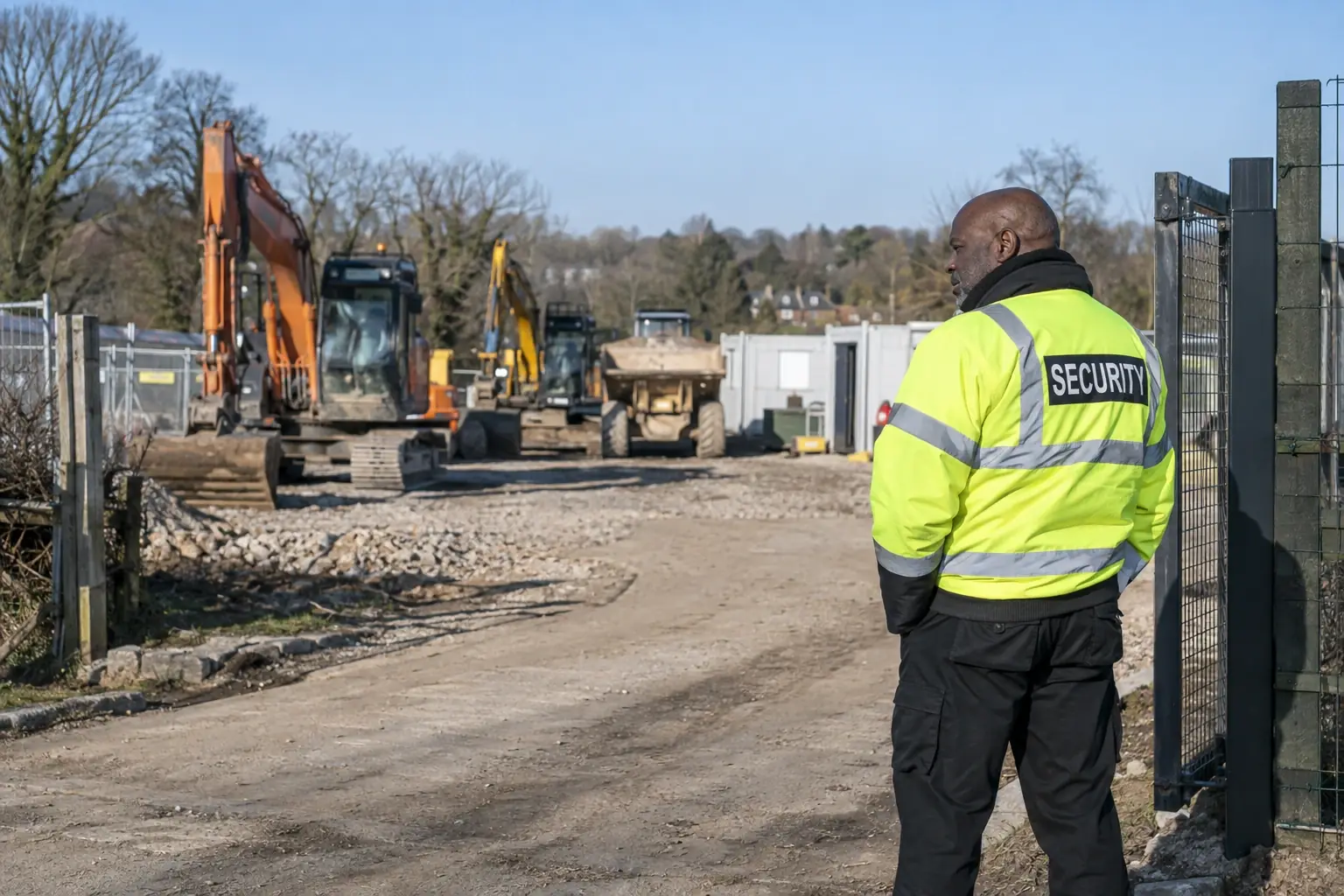
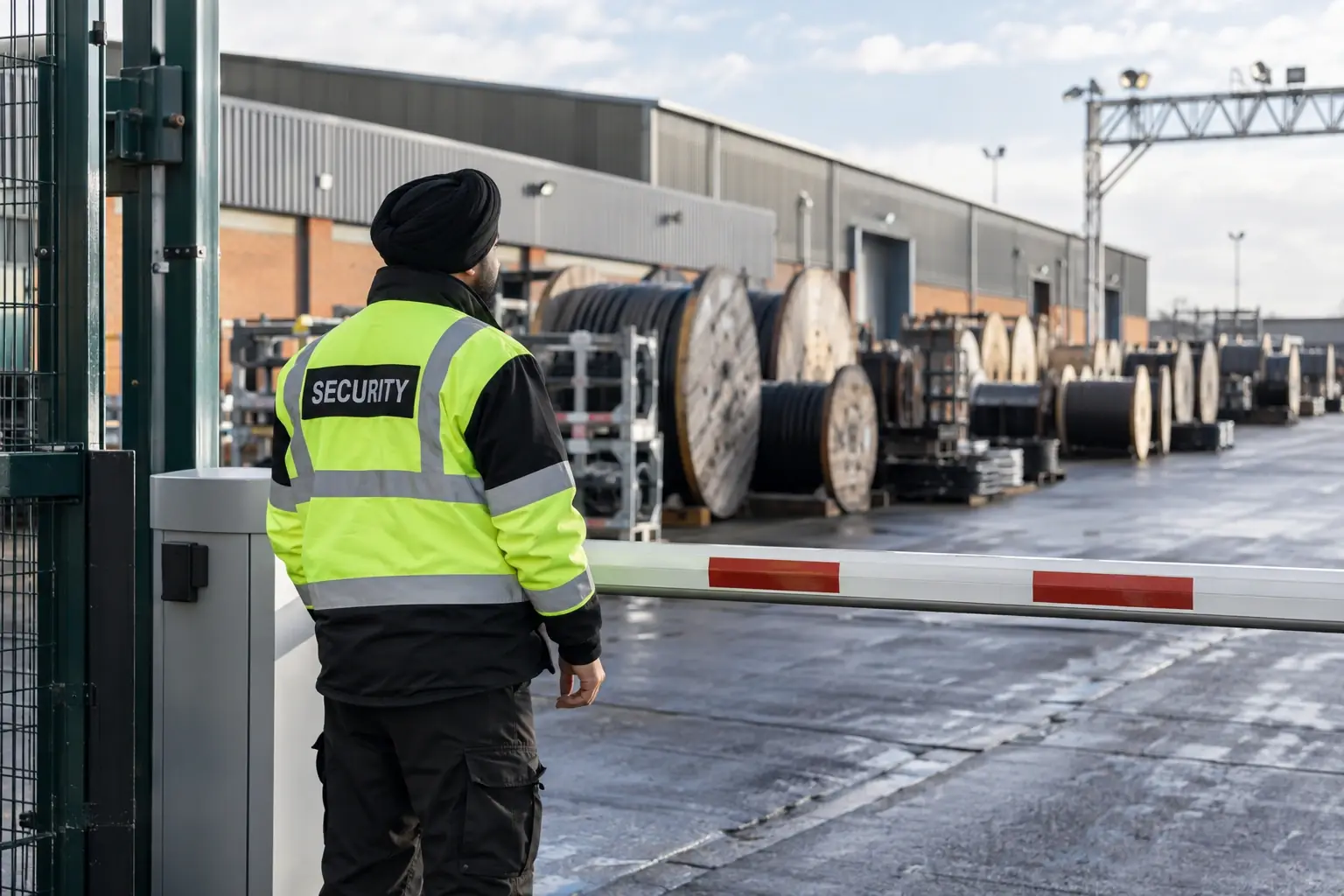

Two incidents from 2026 illustrate the scale. In January, a theft at Moulton Chapel in Lincolnshire affected 2,500 premises. In May, three men were jailed over a cable theft in Birmingham that disrupted service for 5,000 people.
Andy Shepherd of Openreach: “Cable theft causes serious damage, unacceptable disruption to communities and can put vulnerable people at risk.” Bruce Miller of EMR added that metal theft is “disrupting communities, damaging essential infrastructure and putting public safety at risk”.
For a contractor, the reputational exposure is proportionate to that disruption. A theft from a compound is a commercial matter. A theft that removes telephony from a village, including from people who depend on it to call for help, is a public one, and it is reported as such.
Civil engineering site security law: CDM 2015, excavations and scrap metal
Five instruments bear on civil engineering site security. They operate independently, and compliance with one does not discharge the others.
What does CDM 2015 require on unauthorised access?
Regulation 13(4)(b) requires the principal contractor to ensure that “the necessary steps are taken to prevent access by unauthorised persons to the construction site”. On a linear scheme the phrase “the construction site” covers the whole of the works, not only the compound, and the steps must be necessary for the risk actually present along it.
Read regulation 13What does the law say about open excavations?
Regulation 22(1) requires all practicable steps to prevent danger to any person from collapse or falling material. Regulation 22(2) requires “suitable and sufficient steps” to prevent “any person, work equipment, or any accumulation of material from falling into any excavation”. The duty is owed to any person, which includes someone who entered without permission.
Read regulation 22Does the Health and Safety at Work Act reach non-employees?
Yes. Section 3 requires employers to conduct their undertaking so that people who are not their employees are not exposed to risks to their health or safety. Section 37 extends liability to directors and managers where an offence is committed with their consent or connivance, or through their neglect.
How does the Scrap Metal Dealers Act 2013 affect site security?
It governs the market that stolen cable is sold into. Section 1 requires dealers to hold a licence, section 11 requires verification of a supplier's identity, section 12 creates an offence of buying scrap metal for cash, and sections 13 to 15 require records of metal received and disposed of. For a contractor the practical relevance is evidential: material marked, recorded and traceable is materially harder to convert into cash.
Read the ActMust site security officers be licensed?
Yes. Under the Private Security Industry Act 2001, officers supplying manned guarding under contract must hold a valid SIA licence for the activity they carry out. Framework clients increasingly audit this. Every AGS officer is SIA licensed.
Civil engineering security prosecutions: recent HSE enforcement
Two judgments handed down in 2026 bear directly on civil engineering site security and how civils sites are controlled. Neither turned on an exotic failure.
SCS Railways Limited
The HS2 joint venture of Skanska, Costain and Strabag was fined £400,000 with £8,974 costs at Uxbridge Magistrates' Court on 16 June 2026, under section 3(1) of the Health and Safety at Work etc. Act 1974. A 20-tonne tipper truck fell around two metres from an unprotected excavation ramp edge at Copthall North near Uxbridge. HSE inspector Gordon Carson found that the company had detailed procedures for much of the work, but that its “failure to properly plan and promptly communicate changes in vehicle routes created unsafe conditions”.
Alchemist DB Limited
A labourer, Mykhalio Hustei, drowned after falling into a rainwater-filled excavation while walking back to his accommodation adjoining the site in Bovingdon, Hertfordshire. Excavations criss-crossed the site with no designated walkways, temporary bridges were unsecured boards without handrails, and there was no dedicated lighting. Sentenced at Luton Magistrates' Court on 29 May 2026 under CDM 2015 regulation 22(2). The HSE inspector's conclusion was that “the site was quite literally a death trap”.
The first case is about civil engineering site security that did not change when the site did. The second is about a site nobody was accountable for once work stopped for the day. Both are security failures as much as safety failures, and on a civils project the two are seldom separable.
For context, HSE recorded 126 workers killed in work-related incidents in Great Britain in 2025/26, 25 of them in construction, alongside 104 members of the public killed in work-related incidents.
Which site security services suit a civil engineering project that keeps moving?
Fixed measures suit fixed sites. Civil engineering site security needs controls that relocate with the programme. These are the arrangements AGS Security deploys on civil engineering and infrastructure projects and on utilities and energy sites.
Compound gatehouse control
The compound holds the plant, the fuel and the cable. A staffed gate records every vehicle in and out, which is the single most useful record you can hold when a load goes missing.
Mobile patrols along the route
The only proportionate way to cover a linear site. Randomised timing, GPS-logged attendance and a written report per visit, covering compounds, laydown areas and working faces in one circuit.
Static guarding at risk points
Where cable is stored, where plant is parked, or where a section has already been targeted. A repeat theft at the same location is a planning failure, not bad luck.
K9 handlers
Effective across open ground and rural sections where sightlines are long and a foot patrol is slow. A licensed handler and general purpose dog will clear a compound in a fraction of the time.
Redeployable CCTV towers
Solar and battery towers move with the compound and cover laydown areas without a power supply or a cable run. Monitored towers escalate to a response rather than simply recording the loss.
Key holding and alarm response
Removes the 3am call from the site agent. Key holding places attendance with us, with an incident report and photographs by morning.
Security patrol records and client assurance on infrastructure frameworks
Civil engineering site security is audited by infrastructure clients. Framework agreements carry assurance obligations, and after an incident the first request is usually documentary: who was on site, when was it last checked, what did the last patrol find.
A guarded site produces that record as a by-product. Gate logs, GPS-stamped patrol reports and incident write-ups demonstrate that the steps required under CDM 2015 were not only specified in the construction phase plan but actually taken, on the night in question.
The same record shortens insurance claims and supports prosecution when material is recovered. Without it, a contractor is asserting that reasonable steps were taken and offering nothing to show it.
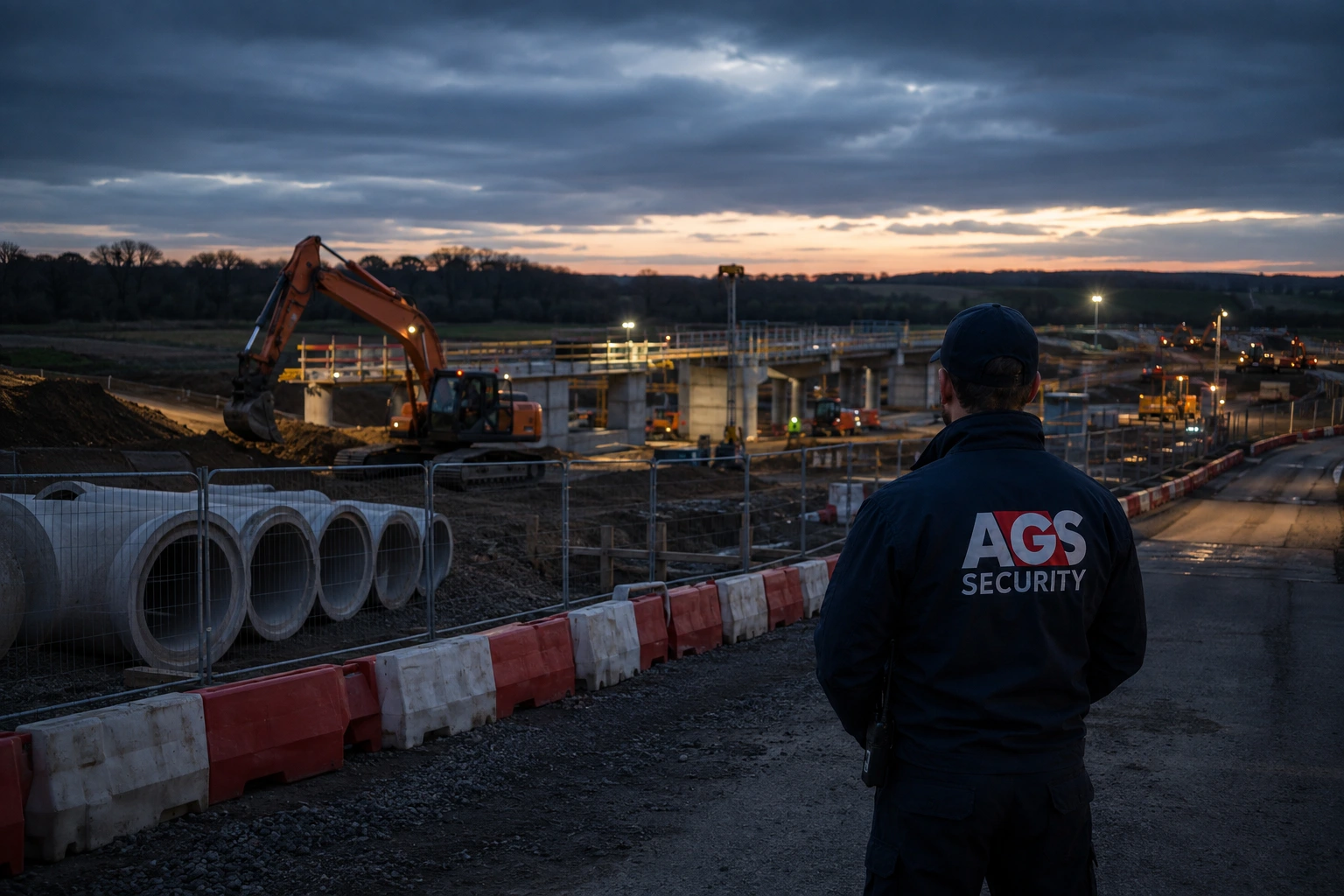
Civil engineering site security checklist before the next phase
Civil engineering site security should be reviewed whenever a compound moves, a new laydown area opens, or the traffic management is reconfigured.
- Does the current security plan describe the site as it is now, or as it was at mobilisation?
- How many vehicle access points exist today, and is every one of them controlled or physically closed out of hours?
- Is cable stored in a locked container or a lay-down stack, and is it marked and recorded?
- Are excavations covered, barriered or backfilled at the end of every shift, along the whole route rather than only near the compound?
- Is there lighting where people move on foot after dark, including any accommodation adjoining the works?
- Is plant immobilised and keyed out, or left ready to start?
- Who attends an activation out of hours, and what is the realistic time to arrive at the far end of the route?
- Can the security provider evidence a valid SIA licence for every officer who has attended?
- Does the client's framework require a security assurance record, and could you produce one this week?
AGS covers infrastructure schemes nationally, with regional detail for the West Midlands, South Midlands, East Midlands and East of England, and the full list on the locations page.
Civil engineering site security: frequently asked questions
Who is responsible for security on a civil engineering site?
The principal contractor. CDM 2015 regulation 13(4)(b) requires them to ensure the necessary steps are taken to prevent access by unauthorised persons to the construction site. The work can be contracted to a security provider, but the duty itself cannot be transferred.
How much does metal theft cost the UK?
Around £500 million a year, and an estimated £4.3 billion cumulatively since 2013, according to figures published by Crimestoppers, Openreach and EMR in May 2026.
Is it illegal to pay cash for scrap metal?
Yes. Section 12 of the Scrap Metal Dealers Act 2013 creates an offence of buying scrap metal for cash. Dealers must also be licensed and must verify the identity of the person supplying the metal.
Do open excavations have to be covered overnight?
CDM 2015 regulation 22(2) requires suitable and sufficient steps to prevent any person, work equipment or accumulation of material falling into an excavation. In practice on an accessible site that means covering, barriering or backfilling before the site is left unattended.
How do you secure a site that is several miles long?
Civil engineering site security works through layered controls rather than a single perimeter: staffed control of the compound where the high-value assets sit, randomised mobile patrols along the route with logged attendance, redeployable CCTV that moves with the works, and static cover at any point already targeted.
Which areas does AGS Security cover?
AGS Security covers sites across England, Scotland and Wales from its base in Wolverhampton, West Midlands, providing manned guarding, gatehouse security, mobile patrols, K9 dog handlers, CCTV monitoring, key holding and alarm response.
Contact AGS Security for infrastructure site security
Tell us the route length, the compound locations and the hours that need covering, and we will set out what the civil engineering site security arrangement should be. Civil engineering site security assessments are carried out without charge or obligation.
Creative Industries Centre, Glaisher Drive, Wolverhampton, West Midlands, WV10 9TG
England, Scotland and Wales — check your area
About the publisher. AGS Security is the trading name of Albrighton Group Services Ltd, a security contractor registered in England and Wales, company number 13057321, registered with the Information Commissioner's Office under registration ZB329521.
The company provides manned guarding, gatehouse security, mobile patrols, K9 dog handling, CCTV monitoring, key holding and alarm response to construction, residential development, civil engineering, industrial, warehousing and commercial property clients across England, Scotland and Wales. Head office: Creative Industries Centre, Glaisher Drive, Wolverhampton, West Midlands, WV10 9TG. Telephone 0333 577 1777.
Arrange a civil engineering site security assessment
A short civil engineering site security visit establishes where the route is exposed, which hours carry the risk, and what level of cover is proportionate to the programme. No obligation and no charge.
This article is general information about civil engineering site security and the duties applying to construction work in Great Britain. It is not legal advice.
Sources: metal theft cost figures and Openreach network data are from the joint Crimestoppers, Openreach and EMR campaign published in May 2026; work-related fatality figures are HSE's provisional 2025/26 statistics; prosecution details are taken from HSE's published enforcement releases covering the sentencing of SCS Railways Limited on 16 June 2026 and Alchemist DB Limited on 29 May 2026.
Duties under the Construction (Design and Management) Regulations 2015, the Health and Safety at Work etc. Act 1974, the Scrap Metal Dealers Act 2013 and the Private Security Industry Act 2001 should be considered with your own legal and health and safety advisers.