
Mobile Patrol or Static Guarding: Why Counting Visits Is the Wrong Way to Buy Either
Almost every mobile patrol contract in Britain is priced and judged on the number of visits per night. That is the one measure that tells you least about whether the site is protected. This briefing sets out what a mobile patrol actually delivers, when static cover is the only honest answer, and why police response to your alarm is conditional and revocable.
Mobile patrol and static guarding: key facts at a glance
The short answers on mobile patrol and static guarding, for readers and for anyone summarising this page.
- Under NPCC policy a nominated keyholder is expected to attend an alarm activation within 20 minutes and to carry keys to unlock all parts of the premises for a full internal and external check.
- Police response is revocable: for intruder alarms, three false calls in twelve months results in response being withdrawn after 14 days' notice. For hold-up alarms it is two.
- Mobile patrol and static guarding are governed by different British Standards — BS 7984-3 for mobile security services, BS 7499 for static guarding — and following them is a condition of SIA approved contractor status.
- The SIA reported more than 446,000 individual licence holders as of February 2025, holding over 500,000 licences, up 21% since December 2020.
- HSE states plainly that health and safety law applies to work activities on the road in the same way as it does on a fixed site, and that driving for work is one of the most dangerous things workers do.
- AGS Security provides mobile patrol, static manned guarding, key holding, alarm response, K9 handlers and CCTV monitoring across England, Scotland and Wales.
What you are actually buying when you buy a mobile patrol
Ask most buyers what their mobile patrol contract provides and they will tell you a number: four visits a night, two at weekends. Ask what those visits achieve and the answer gets vaguer, because the number was never the point.
A mobile patrol delivers three things, and only one of them is the visit. The first is deterrence, which is real but works on presence rather than frequency. The second is detection, which is a function of when the officer arrives relative to when something happened. The third, and the one that pays for the contract when things go wrong, is the record: a timed, dated, photographed report that proves the state of the site at a known moment.
Buyers who understand this stop negotiating on visit count and start negotiating on timing, randomisation and reporting quality. Those three things cost the provider more and cost the client roughly the same.
The comparison with static guarding follows from the same logic. A static officer is not simply more mobile patrol visits stacked together. It is a different product, governed by a different standard, solving a different problem.
If your mobile patrol contract specifies a number of visits but says nothing about randomisation, arrival windows or what the report must contain, you have bought attendance. You have not bought security.
The gap between mobile patrol visits is the product
A four-visit night on a twelve-hour cover period averages one attendance every three hours. Put another way, the site is unobserved for roughly 165 minutes out of every 180. That is not a criticism of mobile patrol; it is the arithmetic of what a patrol is.
Visits a night
One attendance every six hours across a twelve-hour period. Suitable for low-value sites where the purpose is to detect and report rather than to interrupt.
Visits a night
The common commercial specification. One attendance every three hours, leaving a window long enough for a determined entry, a strip and a departure.
Visits a night
Two-hourly. The point at which a mobile patrol starts to compete with static cover on cost, and usually the point to reconsider the whole approach.
Minutes
The keyholder attendance expectation in NPCC policy. A meaningful number, because it is one your provider can be measured against.
What the gap can and cannot absorb
The honest test is to ask what the site loses in three hours. A perimeter breach that is discovered on the next mobile patrol visit and reported within the hour is a manageable event. Copper stripped from a plant room over the same three hours, with the water left running, is not.
Where the loss is fast and irreversible — fuel, cable, plant, tools, anything with a scrap or resale market — the gap is the risk, and adding visits is an expensive way to shrink it. Where the loss is slow and cumulative — deterioration, fly-tipping, low-level trespass, water ingress — a mobile patrol is genuinely the right instrument, because detection within a few hours is soon enough.
The question is never "how many visits can I afford?" It is "what can happen here in the time between them, and can I live with it?" A provider who does not ask that question is selling you visits.
Why a predictable mobile patrol is a timetable for the offender
This is the failure that clients rarely see and providers rarely volunteer. A mobile patrol that attends at the same times every night, arrives from the same direction, parks in the same place and takes the same route through the site is not a deterrent after the second week. It is a published schedule.
Anyone watching a site for a few nights can establish the pattern without effort. Once they have it, the patrol has told them precisely when the site is empty and for how long — information they would not otherwise have had. A predictable patrol can leave a site worse informed than no patrol at all, because the client believes the hours are covered.
What a properly run mobile patrol does instead
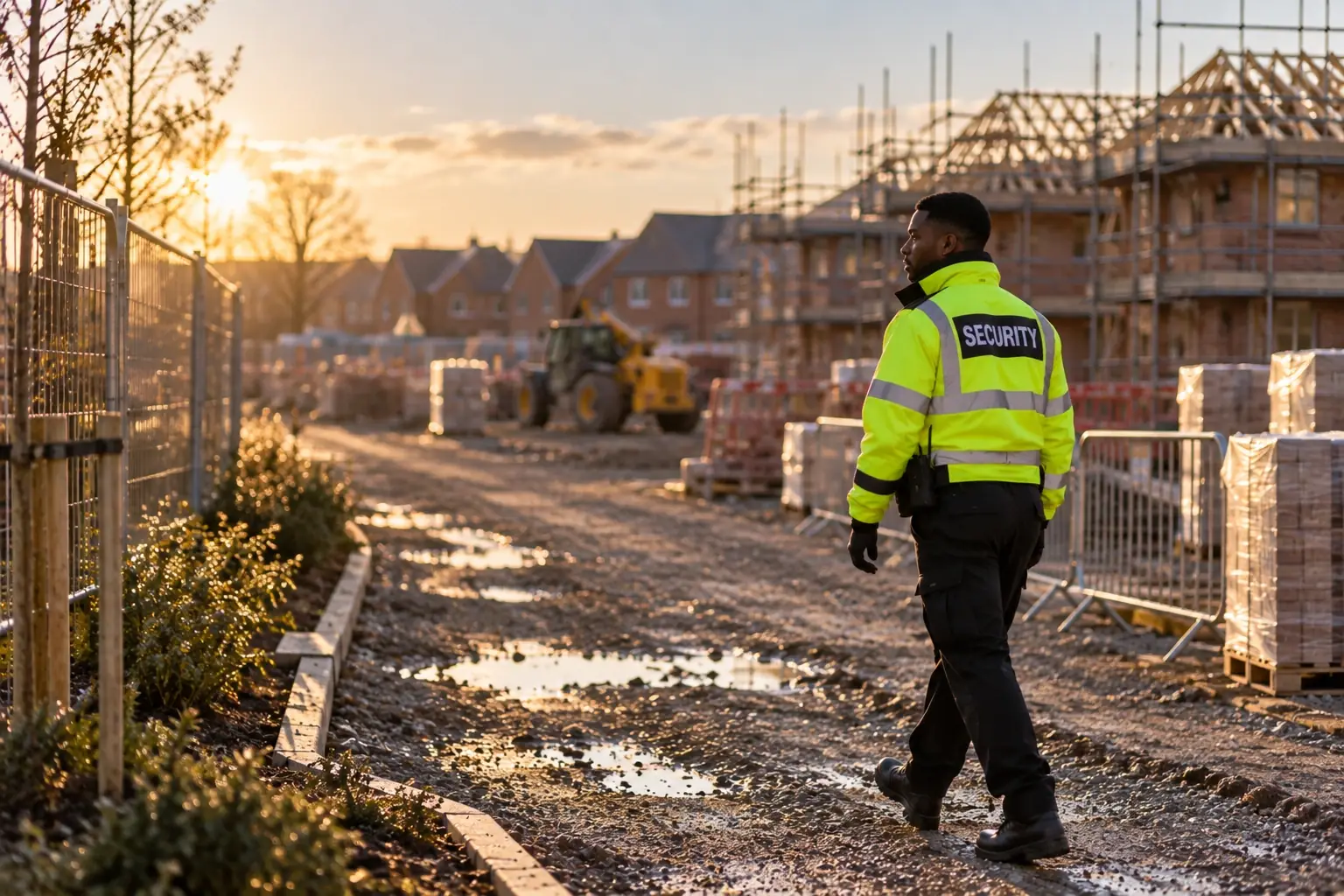
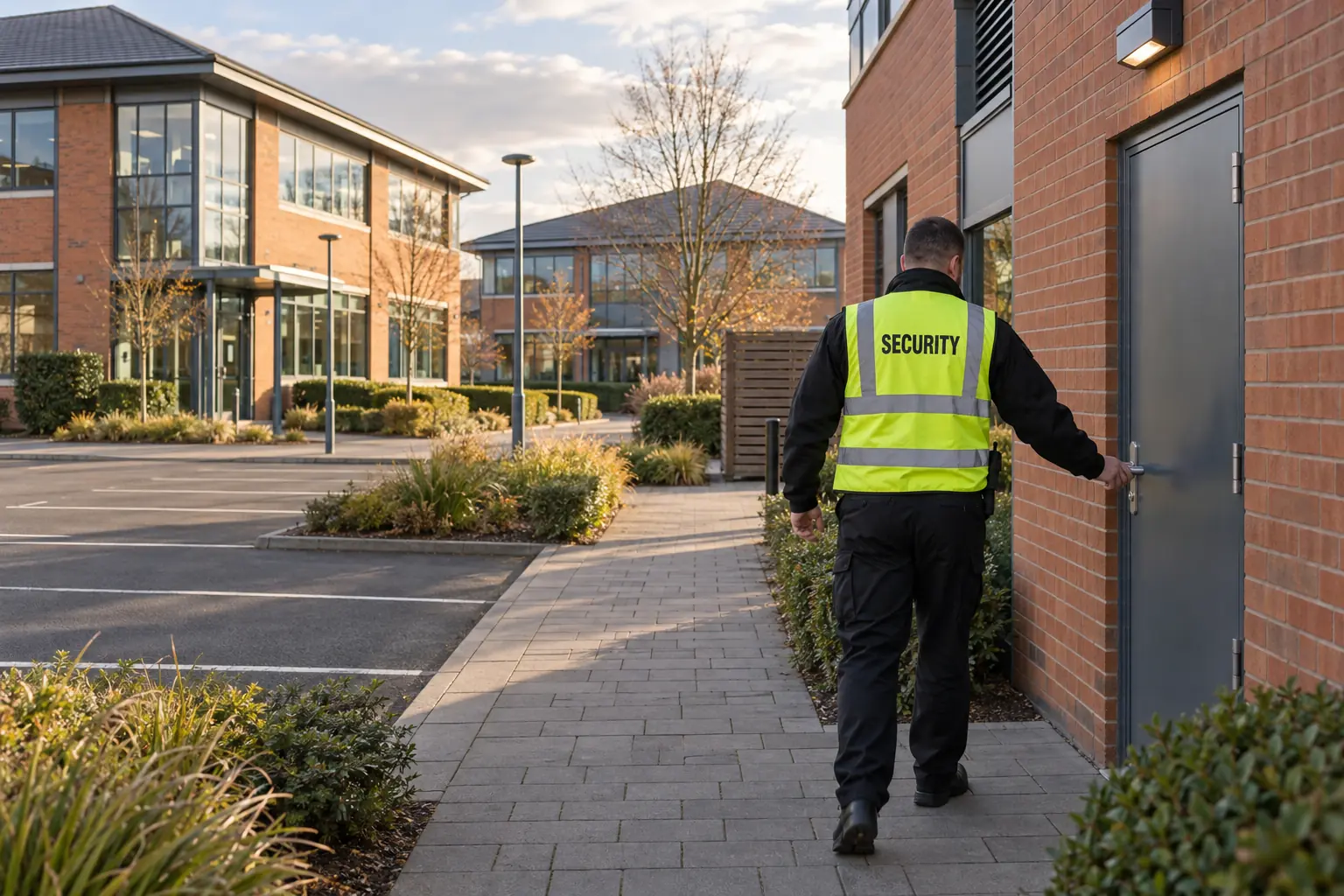
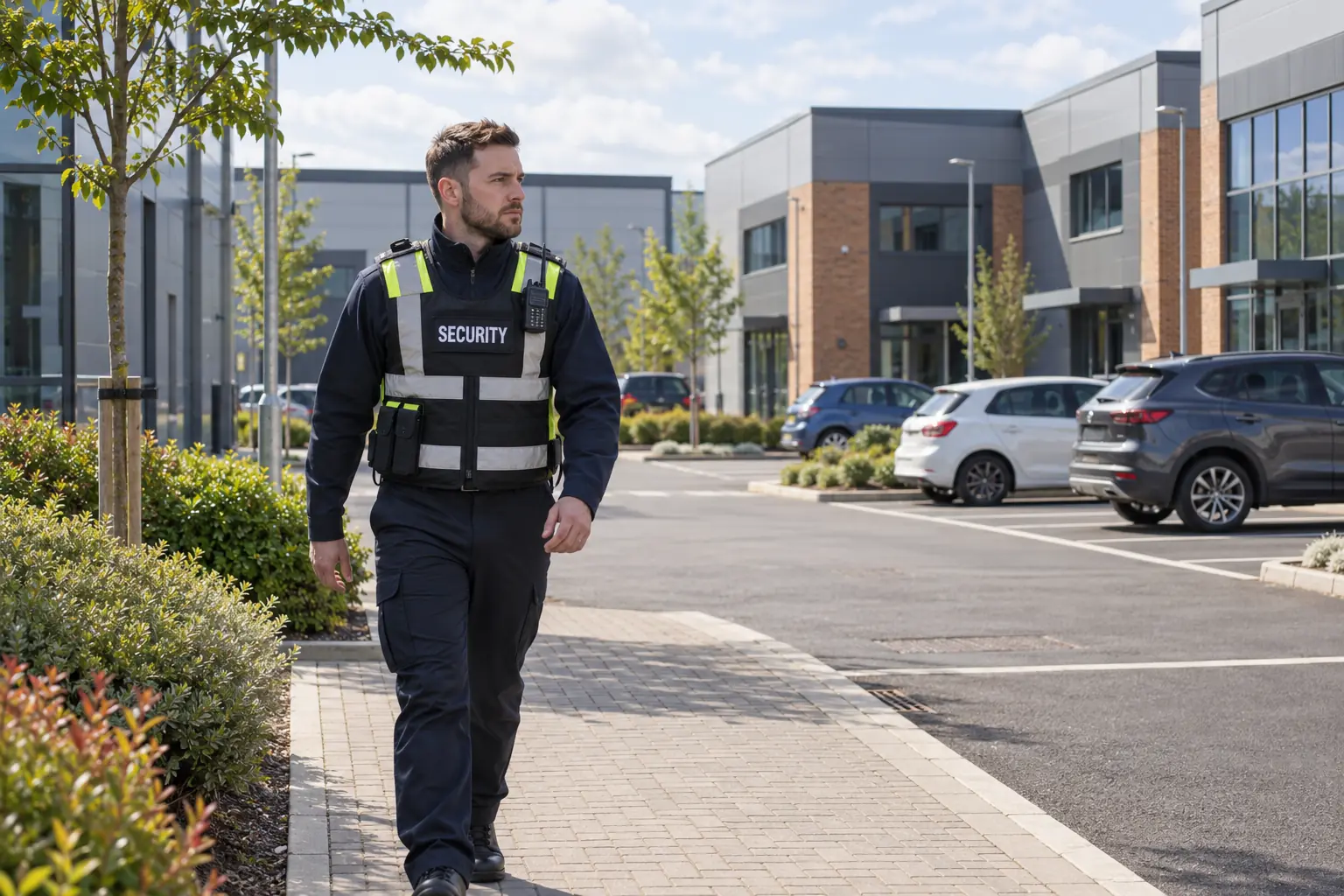
Randomisation within agreed windows costs nothing and changes the value of the contract completely. A specification that says "four visits between 19:00 and 07:00, no two visits within 90 minutes, no fixed pattern across any seven-day period" is a materially better buy than one that says "visits at 20:00, 23:00, 02:00 and 05:00" — at identical cost.
Ask your provider for the actual attendance times over the last month. If you can predict next week's from them, so can everybody else.
When static guarding is the only honest answer
Any provider who tells you a mobile patrol will do on every site is selling what is convenient to supply. There are situations where the gap between visits cannot be managed down to an acceptable level at any sensible price, and in those cases the recommendation should be static cover or nothing.
Where the loss happens faster than the interval
Live fuel bowsers, cable drums, plant compounds, high-value fit-outs and anything with an immediate resale market. If a crew can arrive, load and leave inside ninety minutes, a three-hourly mobile patrol is documenting the theft rather than preventing it.
Where access has to be controlled, not just checked
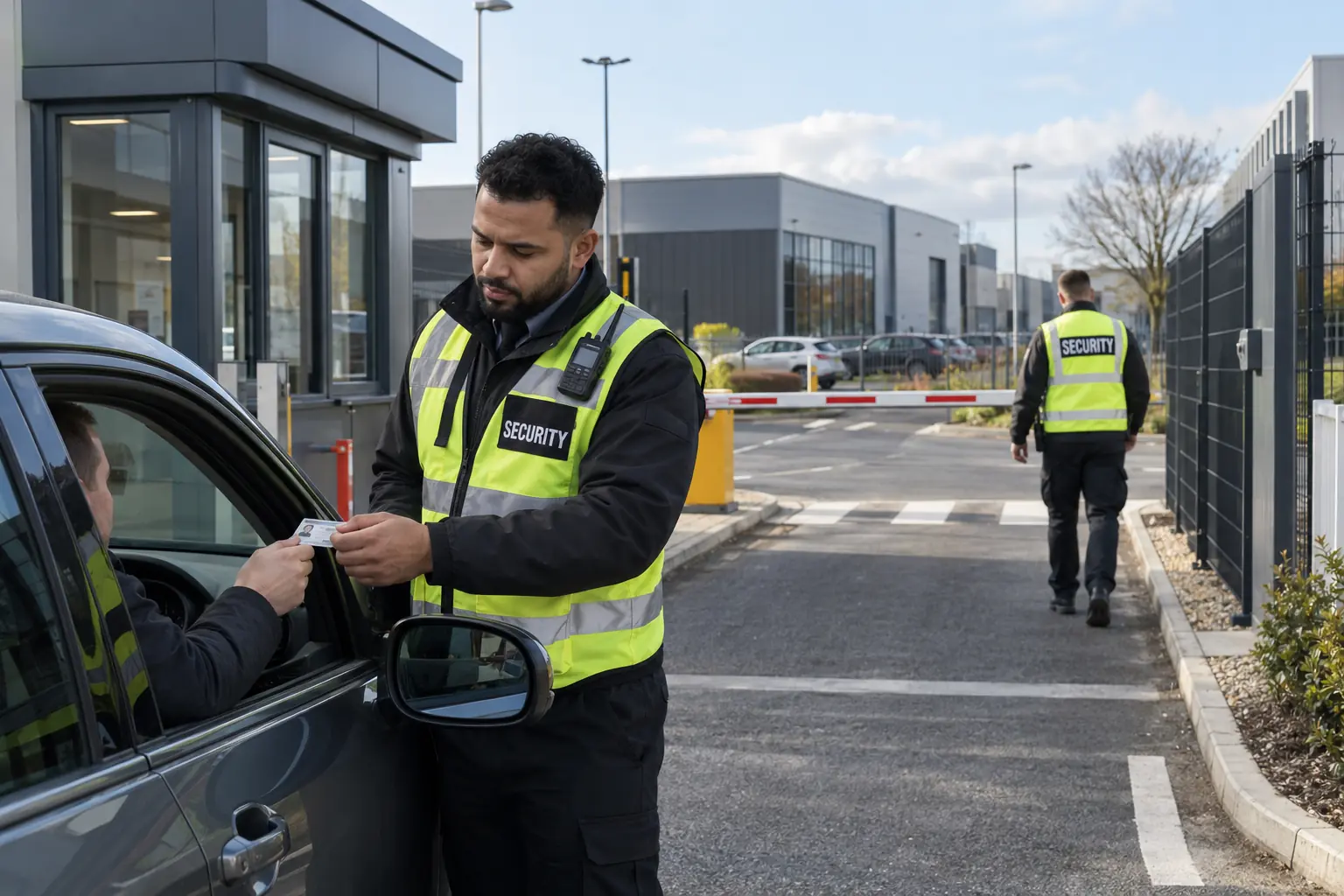
If people and vehicles need to be admitted, verified, inducted or logged, that is a continuous function and no patrol delivers it. Gatehouse and access control work is static work by definition.
Where there is a live occupation or a repeat offender
Once a site has been entered and occupied, or is being targeted repeatedly by the same people, a mobile patrol becomes a series of confrontations by a lone officer at three-hourly intervals. That is an unsafe deployment as well as an ineffective one.
Where an insurer or a contract requires presence
Some policy conditions and principal contractor requirements specify continuous manned presence rather than inspection. Where that is the term, a mobile patrol does not satisfy it however frequent, and substituting one is a breach you will discover at claim stage.
The middle ground that usually works
Most sites do not need a binary answer. The common effective arrangement is static cover across the high-risk hours — typically the first part of the night and the pre-dawn window — with a mobile patrol covering the shoulders and weekends, plus alarm response underneath both. That costs less than round-the-clock static and considerably outperforms a patrol-only specification.
Mobile patrol, keyholding and the 20 minute rule
This is the part of the picture most buyers have never been shown, and it changes how an alarm should be thought about entirely. Police response to an intruder alarm is not automatic, not unconditional, and not permanent.
Response depends on a URN, and the URN can go
Police-linked systems are issued with a Unique Reference Number that an approved alarm receiving centre must quote when passing an activation. Under NPCC policy, an intruder alarm generating three false calls in a rolling twelve months has its response withdrawn after 14 days' notice. For hold-up and personal attack alarms the threshold is two false calls. Once withdrawn, the system drops to keyholder response only.
The keyholder standard is specific
NPCC policy sets an expectation that a nominated keyholder attends within 20 minutes, and that they carry keys to unlock all parts of the premises in order to carry out a full internal and external check. A director who lives forty minutes away, holds one set of keys and cannot access the rear compound does not meet that standard.
Read together, these two facts make the commercial case for professional key holding better than any sales argument. An alarm without a compliant keyholder is an alarm on a countdown: three unlucky activations and the police element of the response is gone, leaving whatever you had arranged privately. If nothing was arranged privately, the alarm is now a noise.
Why this is a mobile patrol question
A mobile patrol operation is usually the only structure that can realistically deliver a 20 minute attendance across a portfolio at three in the morning, because there is already a licensed officer in a vehicle within range. That is the genuine argument for buying patrol and response together rather than separately, and it has nothing to do with visit counts.
Worth checking this week: does your alarm hold a current URN, how many false calls has it generated in the last twelve months, and who is the nominated keyholder on the ARC's record? A surprising number of organisations cannot answer the third question.
The British Standards that govern mobile patrol and static guarding
Mobile patrol and static guarding are not variations of one service. They sit under separate British Standards, and the SIA states that following the British Standards is a condition of approval for its approved contractors.
Which standard covers what
BS 7984-3 covers the provision of mobile security services. BS 7984-1 covers keyholding and response generally, and BS 7984-2 covers lone worker response services. Static guarding sits under BS 7499. Vacant property protection has its own standard, BS 8584, and general-purpose security dogs sit under BS 8517-1. Screening of personnel is BS 7858, CCTV management and operation BS 7958, and body worn video BS 8593.
See the SIA listWhy the distinction is a buying tool
It gives you a precise question to ask. A provider quoting for mobile patrol should be able to say how they work to BS 7984-3, and a provider quoting static cover should reference BS 7499. A provider who treats the two as interchangeable is telling you something about how the contract will be run.
SIA licence holders
More than 446,000 individuals held SIA licences as of February 2025, between them holding over 500,000 licences.
Growth since 2020
Licence holders rose from 365,226 in December 2020 to 442,796 in December 2024.
Revocations forecast
The SIA's own 2025-26 business plan projects 7,000 licences revoked in the year, alongside 840 compliance cases opened.
ACS returns a year
Approved contractor annual returns and renewals forecast for 2025-26. Approval is voluntary, and the scheme is a small fraction of the industry.
That last pairing is the one worth sitting with. Against nearly half a million licence holders, the approved contractor register runs to a few hundred organisations. Holding a licence is a legal minimum for an individual. It says nothing about how the company deploying them is run, which is why the standards question matters.
The risk your mobile patrol contractor carries on your behalf
Buyers assess a security contract for what it protects. It is worth also assessing it for what it creates, because a mobile patrol operation concentrates two of the highest-risk activities in ordinary commercial life: driving at night, and working alone.
Driving is the largest hazard in the service you bought
HSE is unambiguous: “health and safety law applies to work activities on the road in the same way as it does on a fixed site”, and “driving for work is one of the most dangerous things workers will do”. Employers must risk assess the journey, the driver and the vehicle, managing traffic and weather, fatigue and distraction, time pressures and vehicle condition. A patrol schedule that cannot be driven safely in the time allowed is a health and safety failure before it is a service failure.
HSE guidance for employersEvery mobile patrol officer is a lone worker
HSE requires that employers “must manage any health and safety risks before people can work alone”, noting that lone workers face “greater risks without direct supervision or anyone to help them if things go wrong” and that many are also exposed to work-related road risks. On a patrol contract both exposures apply to the same person on the same shift.
The industry has been prosecuted on exactly this point
G4S Care and Justice Services (UK) Ltd was fined £250,000 with £13,787 costs at Milton Keynes Magistrates' Court on 25 June 2021, under sections 2(1) and 33(1)(a) of the Health and Safety at Work etc. Act 1974. An officer with three to four months' service, working alone, was assaulted at Oakhill Secure Training Centre in March 2017 and suffered brain damage, spending three weeks in an induced coma. The HSE inspector said that if proper procedures and supervision had been in place to prevent inexperienced officers working alone in high-risk situations, the life-changing injuries could have been prevented. That was a custodial setting rather than a patrol round, but the duty it turns on is the one every security employer owes.
None of this is abstract for a client. A contractor cutting corners on driver hours, vehicle condition or lone worker monitoring is a contractor whose officers will eventually miss attendances, rush checks and leave gaps in the record you are relying on.
Choosing between mobile patrol and static guarding
Four questions settle most cases, and none of them is about budget.
How fast is the loss? If the site can be stripped inside the interval between visits, a mobile patrol is documentation. If the damage accumulates over days, patrol is the right instrument.
Does anyone need admitting? Access control is continuous. Inspection is periodic. They are different jobs and only one of them can be done from a vehicle.
Has it happened already? A site with a live occupation or a repeat offender needs presence, not visits. Sending a lone officer into a known confrontation every three hours is the wrong answer twice over.
What does the policy or the contract actually say? If continuous presence is a condition, no frequency of mobile patrol satisfies it.
Mobile patrol and the services that sit around it
Patrol rarely works alone. These are the arrangements AGS Security combines on most contracts.
Mobile patrol
Randomised attendance within agreed windows, internal and external checks, and a timed, dated, photographed report after every visit.
Static manned guarding
Continuous licensed presence where the interval between patrol visits is longer than the site can absorb.
Key holding
Keys held securely off site, so no member of your staff attends an activation alone at night and the nominated keyholder standard is genuinely met.
Alarm response
A licensed officer attends the activation, establishes the cause, secures the premises and reports — the private layer that remains when police response is withdrawn.
CCTV monitoring
Live monitoring that shortens the gap between mobile patrol visits without adding attendances, where the camera coverage supports it.
K9 handlers
For large footprints and repeatedly targeted sites, where one officer on foot cannot cover the ground and visible deterrence matters from the boundary.
Applied across commercial property, industrial sites, residential development and unoccupied property.
Mobile patrol and static guarding: a buyer's checklist
Ten questions worth putting to any provider, including your current one.
- What can be lost from this site inside the interval between visits, and does the specification reflect that?
- Are attendance times randomised within windows, or fixed? Can you see last month's actual times?
- Does the specification set a minimum gap between visits, so two do not fall together and leave a long tail?
- What must the report contain — times, photographs, named officer, condition of specific assets — and where is it stored?
- Which British Standard does the provider work to for this service, BS 7984-3 or BS 7499?
- Can they evidence a valid SIA licence for every officer who has attended your site?
- Does your alarm hold a current URN, and how many false calls has it generated in the last twelve months?
- Who is the nominated keyholder on the alarm receiving centre's record, and can they attend within 20 minutes with keys to every part?
- How does the provider manage driver hours, vehicle condition and lone worker monitoring on night rounds?
- Is there a lawful basis, retention period and named owner for the body worn video, CCTV and visit data?
AGS covers sites nationally, with regional detail for the West Midlands, East Midlands, South Midlands and East of England, and the full list on the locations page.
Mobile patrol and static guarding: frequently asked questions
Is a mobile patrol cheaper than static guarding?
Per hour of cover, yes, because the officer and vehicle are shared across several sites. Per unit of protection it depends entirely on how fast loss occurs at your site. Above roughly two-hourly attendance the cost advantage narrows and static cover deserves a fresh look.
How many mobile patrol visits a night do I need?
The wrong question. Establish what can be lost in the interval between visits, then set the interval from that. A specification with randomised timing and strong reporting outperforms a higher visit count with fixed times, at the same price.
Do mobile patrol officers need an SIA licence?
Yes. Officers supplying contract security services must hold a valid SIA licence for the activity performed under the Private Security Industry Act 2001. Ask for evidence covering every officer who has attended, not a sample.
Will the police attend my intruder alarm?
Only if the system holds a current Unique Reference Number and has not lost response. Under NPCC policy three false calls in twelve months withdraws intruder alarm response after 14 days' notice; for hold-up alarms the threshold is two. After that it is keyholder response only.
What is the 20 minute keyholder rule?
NPCC policy expects a nominated keyholder to attend an activation within 20 minutes carrying keys to unlock all parts of the premises for a full internal and external check. A professional key holding and response arrangement is usually the only reliable way to meet it.
Which areas does AGS Security cover?
AGS Security provides mobile patrol, static guarding, key holding, alarm response, CCTV monitoring and K9 handlers across England, Scotland and Wales from its base in Wolverhampton, West Midlands.
Contact AGS Security about mobile patrol and static guarding
Tell us the site, the hours that worry you and what has already happened there, and we will set out whether mobile patrol, static cover or a combination is proportionate. Site assessments are carried out without charge or obligation.
Creative Industries Centre, Glaisher Drive, Wolverhampton, West Midlands, WV10 9TG
England, Scotland and Wales — check your area
About the publisher. AGS Security is the trading name of Albrighton Group Services Ltd, a security contractor registered in England and Wales, company number 13057321, registered with the Information Commissioner's Office under registration ZB329521.
The company provides manned guarding, gatehouse security, mobile patrol, K9 dog handling, CCTV monitoring, key holding, fire watch and alarm response to construction, residential development, civil engineering, industrial, warehousing and commercial property clients across England, Scotland and Wales.
Head office: Creative Industries Centre, Glaisher Drive, Wolverhampton, West Midlands, WV10 9TG. Telephone 0333 577 1777.
Arrange a mobile patrol and site security assessment
A short visit establishes how fast loss can happen on your site, what interval it can absorb, and whether patrol, static cover or a combination is the right answer. No obligation and no charge.
This article is general information about mobile patrol and static guarding services in Great Britain. It is not legal advice, and it is not advice on any particular insurance contract or police force policy — forces apply the national policy locally and your own alarm receiving centre is the authority on your system's status. Sources: NPCC Security Systems (Police Response To) policy as published by Norfolk Constabulary, for the URN framework, false call thresholds, response levels and the 20 minute nominated keyholder expectation; the SIA's published list of British Standards applying to private security, for BS 7499, BS 7984-1, BS 7984-2, BS 7984-3, BS 8584, BS 8517-1, BS 7858, BS 7958 and BS 8593; the SIA Business Plan 2025 to 2026 for licence holder numbers, growth since 2020 and forecast revocations and approved contractor returns; HSE published guidance for employers on driving for work and on lone working; HSE and court reporting of the prosecution of G4S Care and Justice Services (UK) Ltd at Milton Keynes Magistrates' Court on 25 June 2021. Duties under the Health and Safety at Work etc. Act 1974 and the Private Security Industry Act 2001, and the terms of your own insurance and alarm contract, should be considered with your own legal, broking and health and safety advisers.