
Construction Site Security Law: Who Is Responsible for Unauthorised Access to a Housing Development?
Trespass on a part-built estate is not only a theft problem. It is a legal exposure that sits with the principal contractor, and in some cases personally with directors. This construction site security guide sets out the duties, the current figures, two recent prosecutions, and the controls that stand up to scrutiny.
Housing development site security: key facts at a glance
The short answers on construction site security, for readers and for anyone summarising this page.
- Under CDM 2015 regulation 13(4)(b), the principal contractor must ensure the necessary steps are taken to prevent access by unauthorised persons to the construction site.
- A duty of care can be owed even to a trespasser under the Occupiers' Liability Act 1984 where the danger is known and the presence of others is foreseeable.
- Section 37 of the Health and Safety at Work etc. Act 1974 allows liability to extend personally to directors and managers.
- HSE recorded 126 workers killed in Great Britain in 2025/26, 25 of them in construction, alongside 104 members of the public killed in work-related incidents.
- Contract security officers must hold a valid SIA licence under the Private Security Industry Act 2001.
- AGS Security provides manned guarding, gatehouse, mobile patrols, K9 handlers and CCTV monitoring to construction and residential development sites across England, Scotland and Wales.
Construction site security law: what CDM 2015 requires on unauthorised access
Four separate legal duties bear on construction site security and unauthorised access to a live site. They operate independently, so satisfying one does not discharge the others.
Does CDM 2015 require a site to be secured?
Yes. Regulation 13(4)(b) of the Construction (Design and Management) Regulations 2015 states that the principal contractor must ensure that “the necessary steps are taken to prevent access by unauthorised persons to the construction site”. HSE cites regulations 15(10) and 4(6) alongside it. The test is what is necessary for the risk on that particular site, not what is convenient or customary.
Read regulation 13 on legislation.gov.ukIs a duty owed to someone who was trespassing?
It can be. Under section 1 of the Occupiers' Liability Act 1984 a duty arises where the occupier is aware of the danger, knows or has reasonable grounds to believe someone is or may come into its vicinity, and the risk is one against which they may reasonably be expected to offer protection. Where those conditions are met the duty is “to take such care as is reasonable in all the circumstances”. On a development where families already live, foreseeability is difficult to dispute.
Read section 1 on legislation.gov.ukCan a director be personally liable?
Yes. Section 3 of the Health and Safety at Work etc. Act 1974 requires employers to conduct their undertaking so that people who are not their employees are not exposed to risk. Section 37 extends liability to a director, manager or similar officer where the offence was committed with their consent or connivance, or was attributable to their neglect.
Does a security provider need to be licensed?
Yes. Under the Private Security Industry Act 2001, officers supplying manned guarding under contract must hold a valid SIA licence for the activity they carry out. If a provider cannot evidence a licence for every officer who has attended, that becomes the client's compliance problem too. Every AGS officer is SIA licensed.
Why housing development security is harder than single-site construction security
On a commercial project the perimeter is drawn once and stays where it is. On a phased development it moves every few weeks. Phase one is occupied, phase two is at first fix, phase three is groundworks, and the boundary between a finished garden and an open excavation can be a single line of temporary fencing.
That produces a problem no other sector has in quite the same form: the people closest to the risk are the client's own customers. Children live on the estate. Deliveries reach occupied homes along the road that serves the compound. Show homes must look open while the site behind them stays sealed.
It is also a commercial problem. Housebuilders work to sales programmes as well as build programmes. A theft that delays second fix across eight plots does not merely cost the value of the goods, it moves legal completions into the following quarter.
Most developers already have fencing and cameras. What is usually missing is the element that decides whether either works: somebody accountable for the site during the hours nobody is building on it.
In June 2026 HSE publicly urged construction companies to strengthen site security ahead of the school holidays, warning that children have lost their lives after reaching unsecured sites. Housing developments are the sites children are most likely to reach, because children already live beside them.
What does construction site theft cost housebuilders in 2026?
Allianz Cornhill puts the annual cost of theft to UK construction at around £800 million once project delays and insurance are taken into account. Research conducted by Wakefield Research for Samsara in February 2026, covering 1,500 finance executives across construction, logistics, utilities and field services, sets out how that translates into balance-sheet effects.
See premiums rise
More than a third of firms reported a direct increase in insurance premiums following equipment theft.
Hit every quarter
Of operations running without asset tracking, 71% reported equipment theft quarterly. The average time to locate a missing asset was 25 days.
Of equipment budget
A quarter of new equipment spend replaces stolen assets rather than adding capacity — a permanent drag on margin.
Small tools alone
Munich Re's HSB subsidiary places annual small tools theft at £98 million, up 5% year on year.
What is typically taken from a residential site
- Copper and cable. First and second fix wiring, and the runs feeding cabins and tower lighting.
- Boilers, cylinders and white goods. High value, easily moved, stored in plots that are watertight but not yet secure.
- Plant and small dumpers. Anything that can be driven onto a trailer overnight.
- Bricks, blocks and roofing materials. Bulk theft from open stockpiles, often loaded directly from the compound.
- Tools from vans and stores. The loss trades feel personally, and the one that damages subcontractor relationships fastest.
- Fuel. Diesel from bowsers and plant tanks, frequently with tank damage costing more than the fuel.
Site security hazards an unauthorised visitor meets on a housing development
Construction site security failures do not stop at stolen materials, which produce an insurance claim. An injured child produces a criminal investigation. In 2025/26 HSE recorded 126 workers killed in work-related incidents in Great Britain, 25 of them in construction, and separately 104 members of the public killed as a result of work-related incidents.

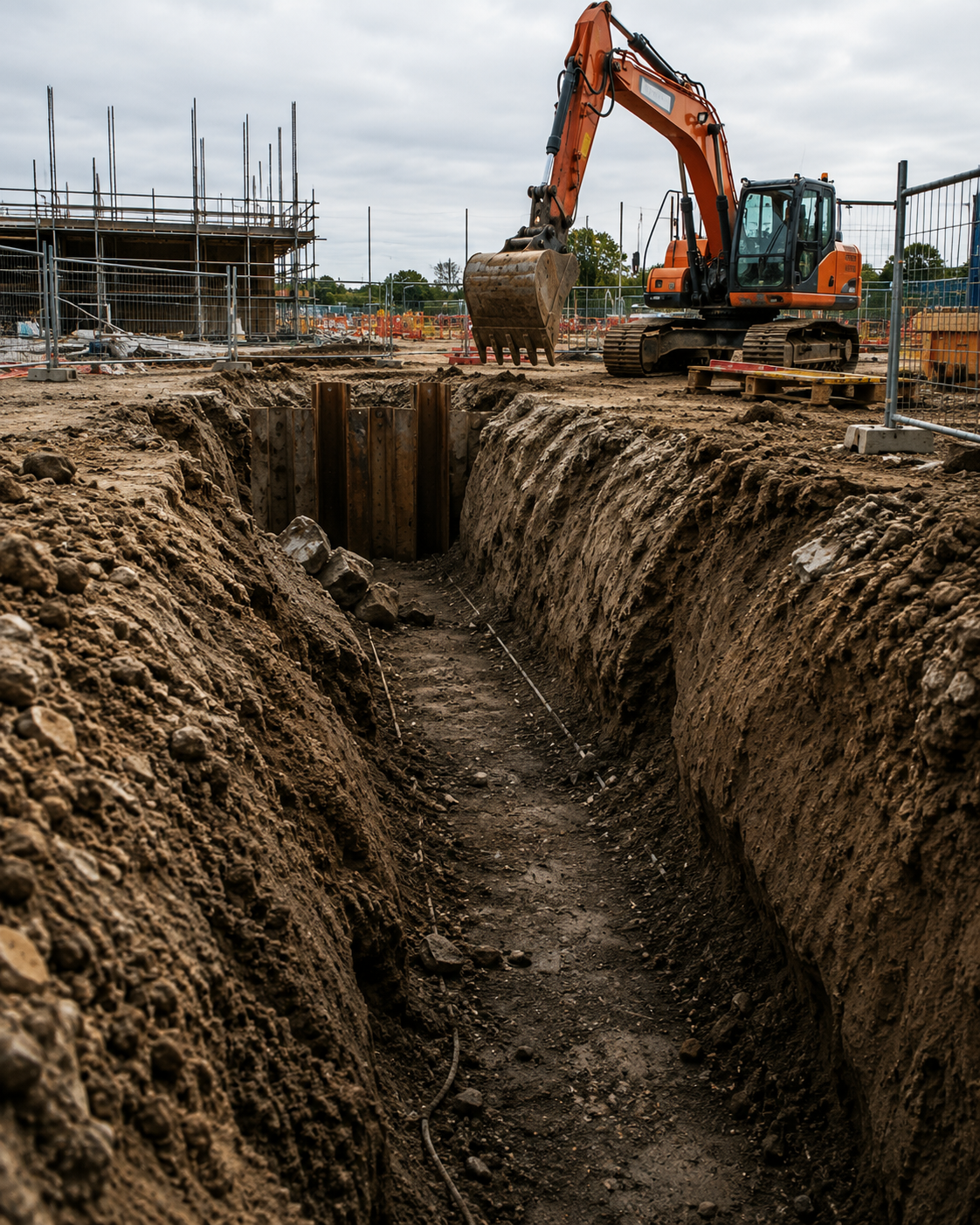

HSE inspector Mike Thomas, June 2026: “Construction sites are places of work and contain numerous hazards, all of which can pose a dangerous threat to anyone entering without permission.” On a residential development, attenuation ponds and open drainage add a drowning risk most other sites do not carry.
Construction site fencing and perimeter security: what HSE expects
HSE's construction site security guidance is specific. Boundaries should be defined physically where necessary, and in populated areas that normally means a two metre high small mesh fence or hoarding around the site. Alongside the perimeter itself, HSE expects:
- Sites secured when work finishes each day
- Excavations covered or barriered
- Vehicles and plant immobilised and locked
- Stored materials secured so they cannot topple
- Access ladders removed from scaffolds
- Hazardous substances locked away
None of these is expensive. All of them depend on somebody carrying them out consistently, and on a record existing to show that they were.
Construction site security prosecutions: what HSE enforcement looks like
Two recent construction site security prosecutions illustrate the pattern. Neither involved a complex construction site security failure.
Stockport Development Limited
An HSE inspection of a home build project on Kingsley Road, Manchester found missing and damaged security fencing alongside absent edge protection, obstructed walkways and inadequate welfare. Enforcement action had already followed four site visits between February 2021 and March 2023. Sentenced at Manchester Magistrates' Court on 12 December 2025 under CDM 2015 regulation 13(1): a £45,000 fine, £18,000 surcharge and £6,297 costs. HSE inspector Claire Whitehurst described “a total disregard for keeping its workers and members of the public safe”.
Sage Homes Limited
In July 2021 a five year old child suffered a fractured skull when a cast iron soil pipe weighing more than 45kg fell on them at a house extension yards from a primary school. The company and its director were sentenced in September 2025 under sections 3(1) and 37 of the Health and Safety at Work etc. Act 1974. The inspector's finding was that “it would have been a simple and inexpensive task to secure the pipe once it had been broken out at its base”.
The common factor is not budget. It is that nobody held responsibility for the condition of the site at the moment the risk existed.
Which construction site security services work on a housing development?
A phased development does not need a single service. It needs a layered arrangement that changes as the phases change. These are the options AGS Security deploys on residential development sites and across wider civil engineering and infrastructure projects.
Gatehouse and access control
Best where deliveries are frequent and sales traffic shares the access. A staffed gate records who is on site, separates visitor routes from construction routes and produces an auditable log.
Static site guarding
Best overnight, at weekends and during shutdowns. The hours a development stands empty are the hours risk peaks, and a static officer both deters entry and responds to it.
Mobile patrols
Best where a permanent presence is disproportionate. Scheduled and randomised visits cover several plots or several developments, with time-stamped reporting on each attendance.
K9 dog handlers
Best on large or repeatedly targeted sites. A licensed handler and general purpose dog cover ground far faster than a foot patrol and materially change the risk calculation for an intruder.
CCTV and redeployable towers
Best where the perimeter moves. Towers follow the build, covering compounds, plot stores and entrances without recabling at every phase.
Key holding and alarm response
Best where site managers are currently the out-of-hours contact. Key holding transfers the response, with a written incident report by morning.
Manned guarding records: why security evidence matters after a site incident
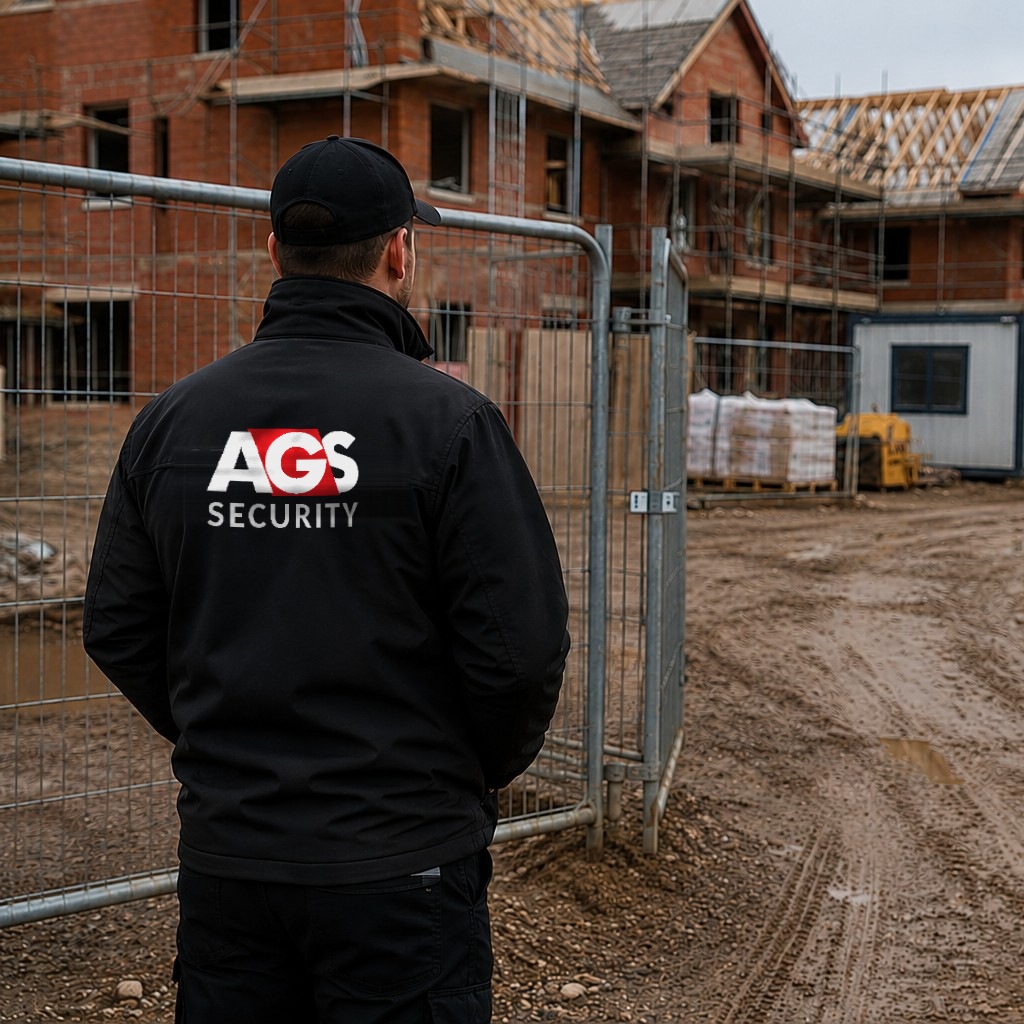
Construction site security starts with a perimeter, and fencing states an intention. Cameras record what happened. Neither stops a group of teenagers climbing a scaffold on a summer evening. A uniformed officer does, because the calculation changes once somebody is present who will intervene.
A staffed site also produces something that matters when an incident is investigated: a contemporaneous record. Patrol logs, gate records and incident reports evidence that the necessary steps under CDM 2015 were not merely specified but actually taken, on the date in question.
Where a development adjoins occupied homes there is a reputational dimension as well. Residents who see a security presence on the estate they have bought into read it as competence.
Construction site security checklist before a holiday shutdown
Whether or not a construction site security contractor is appointed, these are the questions worth asking about every live site before a holiday period or Christmas closure.
- Does the perimeter hold at every phase boundary, including where finished gardens meet live plots?
- Is the hoarding or mesh fence a genuine two metres, and is it inspected rather than assumed?
- Are excavations, drainage runs and attenuation features covered or barriered at the end of every shift?
- Is plant immobilised and are keys removed, or left in the cab because it is quicker in the morning?
- Have access ladders been removed and scaffold alarms or barriers fitted at the lowest lift?
- Is a named person responsible for lock-down, and does a record exist that it was done?
- Who attends when the alarm activates at 2am, and how long do they take?
- Can the security provider evidence a valid SIA licence for every officer who has attended?
- Does the insurer know what protections are in place, and is credit being given for them?
Coverage is available nationally. Regional detail is set out for the West Midlands, South Midlands, East Midlands and East of England, with the full list on the locations page.
Construction site security: frequently asked questions
Who is responsible for security on a construction site?
Construction site security is the principal contractor’s duty. CDM 2015 regulation 13(4)(b) requires them to ensure the necessary steps are taken to prevent access by unauthorised persons. The duty can be discharged through a contracted security provider, but it cannot be transferred away.
Is a construction company liable if a trespasser is injured?
It can be. The Occupiers' Liability Act 1984 can impose a duty towards non-visitors where the danger is known and their presence is foreseeable, and section 3 of the Health and Safety at Work etc. Act 1974 applies to anyone affected by the undertaking, whether or not they had permission to be there.
How high should construction site fencing be?
HSE guidance indicates that in populated areas the boundary should normally be a two metre high small mesh fence or hoarding. The requirement is that boundaries are physically defined where necessary for the risk present.
Do construction site security guards need an SIA licence?
Yes. Officers supplying manned guarding under contract must hold a valid SIA licence for the activity performed, under the Private Security Industry Act 2001. Clients should ask providers to evidence licences for every officer deployed.
What does construction site theft cost the UK industry?
Allianz Cornhill estimates around £800 million a year once project delays and insurance are included. Munich Re's HSB subsidiary places small tools theft alone at £98 million annually, rising 5% year on year.
Which areas does AGS Security cover?
AGS Security covers sites across England, Scotland and Wales from its base in Wolverhampton, West Midlands, providing manned guarding, gatehouse security, mobile patrols, K9 dog handlers, CCTV monitoring, key holding and alarm response.
Contact AGS Security for construction site security
Tell us the phase, the plot count and the hours that need covering, and we will set out what the construction site security arrangement should be. Construction site security assessments are carried out without charge or obligation.
Creative Industries Centre, Glaisher Drive, Wolverhampton, West Midlands, WV10 9TG
England, Scotland and Wales — check your area
About the publisher. AGS Security is the trading name of Albrighton Group Services Ltd, a security contractor registered in England and Wales, company number 13057321, registered with the Information Commissioner's Office under registration ZB329521.
The company provides manned guarding, gatehouse security, mobile patrols, K9 dog handling, CCTV monitoring, key holding and alarm response to construction, residential development, civil engineering, industrial, warehousing and commercial property clients across England, Scotland and Wales. Head office: Creative Industries Centre, Glaisher Drive, Wolverhampton, West Midlands, WV10 9TG. Telephone 0333 577 1777.
Arrange a construction site security assessment
A short construction site security visit establishes where the perimeter fails, which hours carry the risk, and what level of cover is proportionate. No obligation and no charge.
This article is general information about construction site security and the duties applying to construction work in Great Britain. It is not legal advice.
Sources: work-related fatality figures are HSE's provisional 2025/26 statistics; site security guidance and the quoted inspector statement are from HSE's published guidance and press releases; equipment theft findings are from research conducted by Wakefield Research for Samsara in February 2026, with cost estimates from Allianz Cornhill and Munich Re's HSB subsidiary; prosecution details are taken from HSE's published enforcement releases.
Duties under the Construction (Design and Management) Regulations 2015, the Health and Safety at Work etc. Act 1974, the Occupiers' Liability Act 1984 and the Private Security Industry Act 2001 should be considered with your own legal and health and safety advisers.