
Energy Site Security: Why Substations and Renewables Need More Than a Fence
Energy site security is the one field where the law states a height in metres, the assets are lethal to touch, and a single failure can darken sixty thousand homes. This briefing sets out the statutory duties, what network theft actually costs, and the controls that suit remote and live sites.
Energy site security: key facts at a glance
The short answers on energy site security, for readers and for anyone summarising this page.
- ESQCR 2002 regulation 11(b) requires open-air substation equipment that is not encased to be enclosed by a fence or wall not less than 2.4 metres high.
- Regulation 11(a) requires every substation to be enclosed where necessary to prevent danger or unauthorised access, so far as is reasonably practicable.
- Metal theft costs the UK economy around £500 million a year, and £4.3 billion since 2013.
- The Energy Networks Association recorded 680 metal theft cases in 2016 that cut electricity supply to roughly 25,500 homes.
- The North Hyde substation fire on 20 March 2025 cut power to 66,919 customers and closed Heathrow Airport. Its cause was equipment failure, not crime, but it shows the consequence of losing one site.
- AGS Security provides manned guarding, gatehouse control, mobile patrols, K9 handlers and CCTV monitoring to utilities and energy sites across England, Scotland and Wales.
Why energy site security differs from ordinary construction security
Most construction sites are dangerous because of what is being built. Energy sites are dangerous because of what is already there. A substation compound, a solar array with its inverters live, a battery storage installation mid-commissioning: the hazard is not a fall or a trench, it is 11,000 volts or more behind a fence.
That changes the security problem in three ways.
First, an intruder is not merely a commercial loss, they are a probable fatality. Energy site security failures are measured in lives before they are measured in copper.
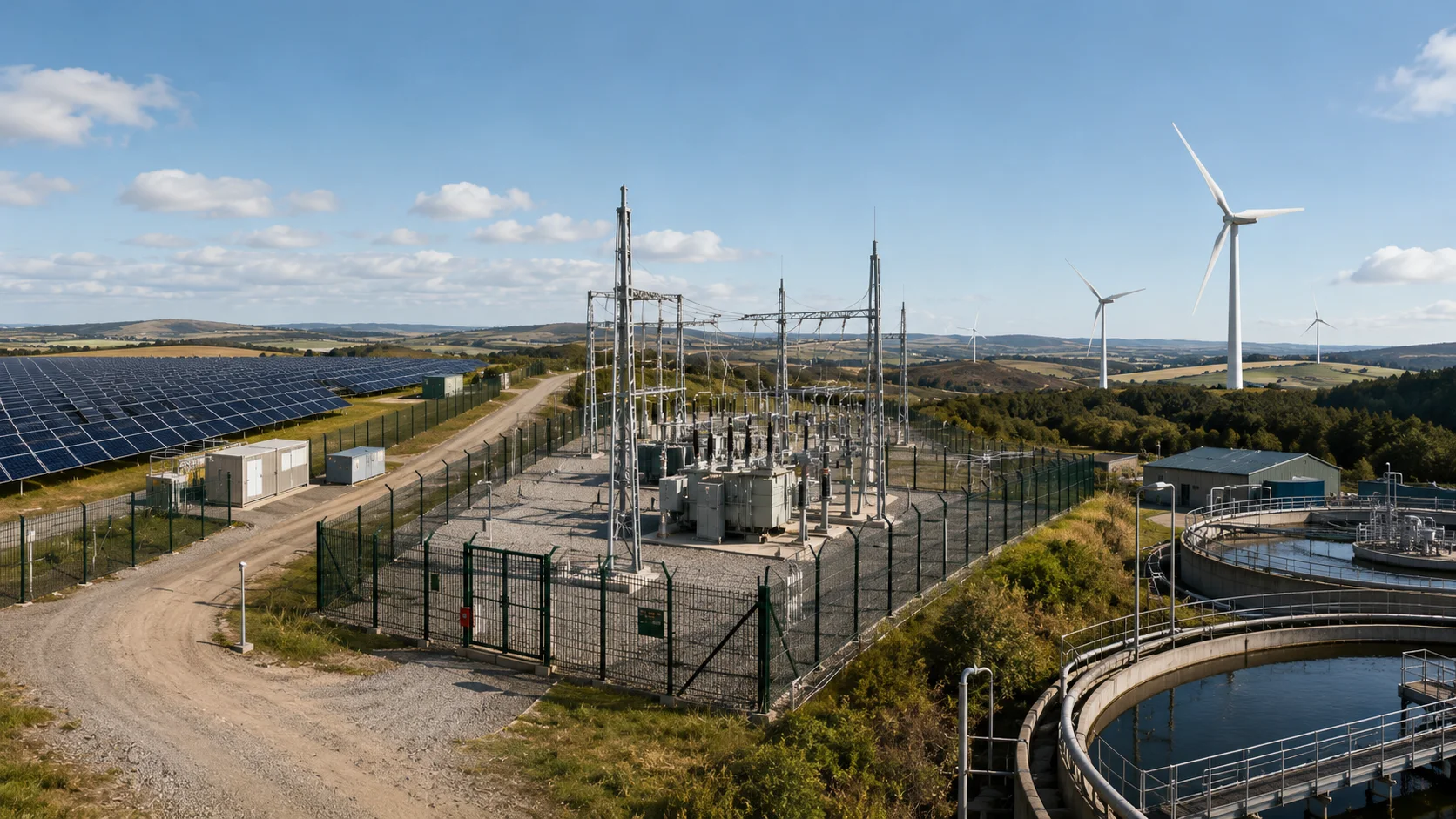
Second, the sites are remote by design. Solar farms and grid connection points are sited away from population, on farmland or brownfield, often miles from a response. The isolation that makes them acceptable to plan makes them attractive to target.
Third, the consequences travel. Damage to a distribution asset does not stay on site. It reaches hospitals, signalling, water pumping and homes, and it does so within seconds.
Energy site security is one of very few areas where a statutory instrument specifies a physical dimension. ESQCR 2002 sets 2.4 metres for open-air live equipment. A standard 2 metre construction hoarding does not meet it.
Energy site security and what metal theft costs the network
Copper is the constant. In May 2026 Crimestoppers, Openreach and metal recycler EMR put the cost of metal theft to the UK economy at around £500 million a year, and £4.3 billion cumulatively since 2013. For the electricity network specifically, the Energy Networks Association has published its own figures.
Supply-loss cases
The ENA recorded 680 metal theft cases in 2016 that resulted in loss of electricity supply, affecting approximately 25,500 homes.
Customers off supply
A single incident in Kent left 94,000 customers without power, with almost 20,000 off supply for more than 24 hours.
Of copper, half a million lost
One Yorkshire theft took around £40 of copper and cost residents and insurers over half a million pounds. The ratio is the point.
Direct cost, 2016
ENA figures put the direct cost of metal theft to network operators at roughly £3 million in 2015, rising to around £5 million in 2016.
What is targeted on an energy site
- Earthing conductor and copper tape. Taken from substation compounds, frequently while the asset is live.
- Solar cabling and inverters. DC string cable is cut in bulk; inverters are removed whole.
- Transformer components and oil. High value, and removal can create an environmental incident as well as a supply one.
- Cable drums on grid connection works. Often the single most valuable item on a compound.
- Plant, welfare and fuel. Standard construction targets during the build phase of any energy scheme.
- Panels themselves. Lower value individually, but a lorry-load is a serious loss and an insurance event.
Energy site security has to account for a thief who is prepared to work near live apparatus. Conventional deterrence assumes a rational actor weighing risk. That assumption does not hold reliably here.
Why energy site security matters: what one substation failure can do
The clearest recent illustration in Britain was not a security incident at all, and it is worth being precise about that. On 20 March 2025 a fire at the North Hyde 275kV substation cut power to 66,919 domestic and commercial customers and closed Heathrow Airport for most of the following day.
The National Energy System Operator's final review, published on 1 July 2025, found the root cause to be moisture entering a transformer's high voltage bushing, with an elevated moisture reading detected in oil samples as far back as July 2018 and not acted on. Hillingdon Hospital, road and rail infrastructure and three data centres were affected. The review made twelve recommendations.
The cause was an asset management failure, not an intrusion. But the consequence profile is identical either way. Anyone assessing energy site security should read North Hyde as a demonstration of what the loss of a single site produces downstream, and price protection against that consequence rather than against the value of the copper.
Energy site security law: the 2.4 metre rule and what else applies
Energy site security is governed by a sector-specific instrument on top of the general construction and safety regime.
What does ESQCR 2002 require at a substation?
Regulation 11 of the Electricity Safety, Quality and Continuity Regulations 2002 requires every generator and distributor, for every substation they own or operate, to: enclose it where necessary to prevent, so far as is reasonably practicable, “danger or unauthorised access”; enclose any open-air part containing live equipment that is not encased “with a fence or wall not less than 2.4 metres in height”; display sufficient safety signs and an identification notice giving a telephone number where a qualified person is in constant attendance; and take all reasonable precautions to minimise the risk of fire.
Read regulation 11Do the Electricity at Work Regulations apply to contractors?
Yes. The Electricity at Work Regulations 1989 apply to work activities on or near electrical systems, and they bite on contractors as well as operators. They sit alongside the Management of Health and Safety at Work Regulations 1999 and, where the work is construction, the Work at Height Regulations 2005.
Does CDM 2015 still apply on an energy project?
During construction, yes. Regulation 13(4)(b) requires the principal contractor to ensure that “the necessary steps are taken to prevent access by unauthorised persons to the construction site”. On a grid connection or solar build, the CDM duty and the ESQCR duty run in parallel and neither discharges the other.
Read regulation 13How does scrap metal legislation support energy site security?
The Scrap Metal Dealers Act 2013 licenses dealers, requires verification of a supplier's identity under section 11, and makes buying scrap metal for cash an offence under section 12. Marked and recorded conductor is materially harder to convert into money, which is why asset marking belongs in an energy site security plan alongside physical measures.
Read the ActMust guarding on an energy site be SIA licensed?
Yes. Under the Private Security Industry Act 2001 officers supplying manned guarding under contract must hold a valid SIA licence for the activity performed. Network operators and EPC clients audit this as standard. Every AGS officer is SIA licensed.
Energy site security enforcement and the fatal risk behind it
Two facts frame the enforcement picture. The first is what happens to people who reach live apparatus. The second is what the courts do about it.
Years old
The Energy Networks Association records that a 16 year old was killed in Leeds in July 2011 attempting to steal copper from a substation, with three other youths arrested. The ENA notes a small number of deaths and a number of significant injuries to members of the public from metal theft on the network.
Willand O&M Limited
At Exeter Crown Court on 3 March 2026, Willand O&M Ltd was fined £51,000 with £28,467 costs under the Electricity at Work Regulations 1989, and contractor New Wave Marine Ltd £30,000 with £8,000 costs. A cherry picker struck an 11,000 volt overhead line at a Devon biogas site in June 2020. Carl Parsons, 34, was killed and a colleague suffered life-altering injuries. HSE inspector Nicole Buchanan noted that work beneath overhead powerlines “is inherently unsafe and these risks should be eliminated wherever possible”.
Neither case turned on a locked gate. Both turned on control of who was where, and on whether anyone had thought about the interaction between people and live apparatus before it happened. That is the substance of energy site security, and it is why a guarded site is a controlled site rather than simply a watched one.
For context, HSE recorded 126 workers killed in work-related incidents in Great Britain in 2025/26, alongside 104 members of the public killed in work-related incidents.
Which energy site security services suit remote and live sites?
Energy site security has to work where there is no passing traffic, often no mains power for the security system itself, and a long response time. This is how AGS Security covers utilities and energy sites and the civil engineering works that build them.
Static guarding on live compounds
Where apparatus is energised or commissioning is under way, a permanent presence is the only control that both prevents entry and can stop someone who has already entered before they reach the equipment.
Gatehouse and contractor control
Energy projects run dense contractor traffic during commissioning. A staffed gate verifies who is on site, holds the permit and induction record, and produces the log the operator will ask for.
Mobile patrols across dispersed assets
Suited to solar arrays, substation estates and multiple sites in one region. Randomised timing with GPS-logged attendance and a written report on each visit.
K9 handlers on open ground
A solar farm perimeter can run for kilometres. A licensed handler and general purpose dog cover that ground far faster than a foot patrol, which matters when a response window is measured in minutes.
Solar CCTV towers
Self-powered, redeployable and monitored, so a remote site is not dependent on a mains feed that may not be energised yet. Monitoring escalates to attendance rather than recording a loss.
Key holding and alarm response
Critical where the nearest company representative is an hour away. Key holding transfers attendance to us, with a written incident report and photographs.
Security patrol records and network operator assurance
Energy site security is audited more heavily than most sectors, because the client is usually a regulated network business with its own reporting obligations. When something happens, the questions are documentary before they are practical.
Gate logs, GPS-stamped patrol reports and incident write-ups evidence that the enclosure, signage and access duties under ESQCR 2002 and the construction duties under CDM 2015 were not only specified but actually maintained, on the date in question.
The same record supports the insurance position on a renewable asset, where underwriters increasingly price on the protections actually in place rather than on the schedule of works.
Energy site security checklist for remote and live sites
Energy site security should be reviewed at energisation, at each commissioning stage, and whenever a compound or laydown area moves.
- Does every open-air enclosure containing uncased live equipment reach the 2.4 metres ESQCR 2002 requires, and has it been measured rather than assumed?
- Are the statutory safety signs and the identification notice with an attended telephone number present and legible?
- Is earthing conductor marked, recorded and, where practicable, of a type with limited scrap value?
- Is cable stored in a locked container rather than on open drums in the compound?
- Does the security system have its own power, or does it depend on a supply that is not yet energised?
- What is the realistic attendance time to this site at 3am, and who has tested it?
- Is there a documented interface between the security provider and the operator's control room?
- Can the provider evidence a valid SIA licence for every officer who has attended?
- Does the asset owner's insurer know what energy site security measures are in place?
AGS covers utilities and energy schemes nationally, with regional detail for the West Midlands, South Midlands, East Midlands and East of England, and the full list on the locations page.
Energy site security: frequently asked questions
How high must a substation fence be in the UK?
Regulation 11(b) of the Electricity Safety, Quality and Continuity Regulations 2002 requires any open-air part of a substation containing live equipment that is not encased to be enclosed by a fence or wall not less than 2.4 metres in height.
Who is responsible for energy site security at a substation?
The generator or distributor that owns or operates the substation carries the ESQCR 2002 duties. During construction the principal contractor also carries the CDM 2015 duty to prevent access by unauthorised persons.
What does metal theft cost the electricity network?
The Energy Networks Association put the direct cost at roughly £3 million in 2015 rising to around £5 million in 2016, with 680 cases in 2016 causing loss of supply to about 25,500 homes. Across the whole UK economy, metal theft is estimated at around £500 million a year.
How do you secure a remote solar farm?
Energy site security on a remote array normally combines a maintained perimeter, self-powered monitored CCTV towers that do not depend on a mains feed, randomised mobile patrols with logged attendance, and K9 or static cover where the site has already been targeted.
Do security officers on energy sites need an SIA licence?
Yes. Under the Private Security Industry Act 2001 contract manned guarding requires a valid SIA licence for the activity performed, and network and EPC clients routinely audit licence records.
Which areas does AGS Security cover?
AGS Security covers sites across England, Scotland and Wales from its base in Wolverhampton, West Midlands, providing manned guarding, gatehouse security, mobile patrols, K9 dog handlers, CCTV monitoring, key holding and alarm response.
Contact AGS Security for energy site security
Tell us the asset type, whether it is energised, and the hours that need covering, and we will set out what the energy site security arrangement should be. Assessments are carried out without charge or obligation.
AGS Security, Science Park, Creative Industries Centre, Glaisher Drive, Wolverhampton WV10 9TG
England, Scotland and Wales — check your area
About the publisher. AGS Security is the trading name of Albrighton Group Services Ltd, a security contractor registered in England and Wales, company number 13057321, registered with the Information Commissioner's Office under registration ZB329521.
The company provides manned guarding, gatehouse security, mobile patrols, K9 dog handling, CCTV monitoring, key holding and alarm response to construction, residential development, civil engineering, utilities and energy, industrial, warehousing and commercial property clients across England, Scotland and Wales. Head office: AGS Security, Science Park, Creative Industries Centre, Glaisher Drive, Wolverhampton WV10 9TG. Telephone 0333 577 1777.
Arrange an energy site security assessment
A short energy site security visit establishes where the perimeter falls short of the statutory standard, which hours carry the risk, and what level of cover is proportionate. No obligation and no charge.
This article is general information about energy site security and the duties applying to electricity infrastructure and construction work in Great Britain. It is not legal advice.
Sources: enclosure, signage and fire duties are quoted from regulation 11 of the Electricity Safety, Quality and Continuity Regulations 2002; network metal theft figures are published by the Energy Networks Association; the £500 million and £4.3 billion economy-wide estimates are from the Crimestoppers, Openreach and EMR campaign of May 2026; the North Hyde outage figures and root cause are from the National Energy System Operator's final review published on 1 July 2025; prosecution details are from HSE's enforcement release covering the sentencing at Exeter Crown Court on 3 March 2026; work-related fatality figures are HSE's provisional 2025/26 statistics.
Duties under the Electricity Safety, Quality and Continuity Regulations 2002, the Electricity at Work Regulations 1989, the Construction (Design and Management) Regulations 2015, the Scrap Metal Dealers Act 2013 and the Private Security Industry Act 2001 should be considered with your own legal and health and safety advisers.