
Industrial Site Security: Why an Empty Unit Is the Riskiest Asset You Own
A working factory is watched all day. The unit next door, void since the last tenant left, is watched by nobody — and it is the one that burns, fills with waste, or acquires occupants you cannot lawfully remove. This briefing sets out why, what the law actually says, and what proportionate cover looks like.
Industrial site security: key facts at a glance
The short answers on industrial site security, for readers and for anyone summarising this page.
- Fire and rescue services in England attended 14,167 fires in buildings other than dwellings in the year to September 2025, up 7.8% on the previous year.
- Squatting is a criminal offence only in residential buildings. Section 144 of LASPO 2012 does not cover commercial or industrial premises, so removal is a civil possession matter.
- Where a building has no occupier running a business, article 3(b) of the Fire Safety Order makes the owner the responsible person for fire safety.
- Under section 59 of the Environmental Protection Act 1990, an occupier can be required to remove unlawfully deposited waste where they knowingly permitted the deposit.
- On 1 September 2026 an empty industrial unit on a Bristol trading estate was destroyed by a fire the service said was possibly started deliberately, drawing 16 appliances from four counties.
- AGS Security provides manned guarding, gatehouse control, mobile patrols, K9 handlers and CCTV monitoring to industrial sites across England, Scotland and Wales.
Why vacant industrial site security is the hardest problem on the estate
Industrial site security on a working unit is largely solved by occupation. People arrive at seven, machines run, deliveries are booked in, and anything unusual is noticed within minutes. Occupation is the most effective security control ever devised, and it costs nothing because the business was going to happen anyway.
Remove the occupier and every one of those advantages inverts at once. Nobody notices the cut fence. Nobody hears the roller shutter. Nobody smells smoke. The building retains all of its value as a target — cable, copper, plant, structural steel, scrap — while losing the one thing that protected it.
The exposure is worst on part-let estates, which is the common case rather than the exception. A landlord with eleven let units and three voids will normally price security around the eleven, because that is where the rent is. The three are where the loss will come from, and a fire in one of them does not respect a party wall.
There is also a timing trap. Void periods are treated as temporary, so the security decision gets deferred pending a letting that may be six months away. The deferral is the risk.
The instinct is to spend on industrial site security in proportion to what a unit earns. The exposure runs the other way: the unit earning nothing is the one carrying the fire, waste and occupation risk for the whole estate.
Industrial site security and the rising number of building fires
Fire is the loss that ends a building rather than dents it, and the national direction of travel is the wrong one. Home Office statistics published on 29 January 2026 record that fire and rescue services in England attended 14,167 fires in buildings other than dwellings in the year ending September 2025.
Other building fires
Attended in England in the year to September 2025 — the category that covers factories, warehouses, workshops and vacant commercial premises.
Year on year rise
Up from 13,143 the previous year. The five-year comparison is also up, by 7.3% against the year to September 2020.
Appliances, one unit
The number of fire engines committed at the peak of the Bristol trading estate fire on 1 September 2026, drawn from Avon, Dorset, Wiltshire and Gloucestershire.
Cordon
The exclusion zone imposed around that single empty unit, requiring evacuation of the surrounding area and closing four roads.
Two points follow for anyone setting an industrial site security budget. The first is that a fire in a void unit is not a private loss: it commits public resources on a scale that attracts scrutiny, and it stops the neighbouring businesses trading. The second is that the ten-year trend being downward, as it is, offers no comfort at all to the owner of the building that burns this year.
Industrial site security failure in practice: Bristol, September 2026
On the evening of Tuesday 1 September 2026, fire took hold in an empty industrial unit on the Brislington trading estate off Emery Road in Bristol. Avon Fire and Rescue Service committed sixteen appliances at the peak, supported by crews from Dorset, Wiltshire and Gloucestershire, and was still damping down hotspots the following day with eight engines on site.
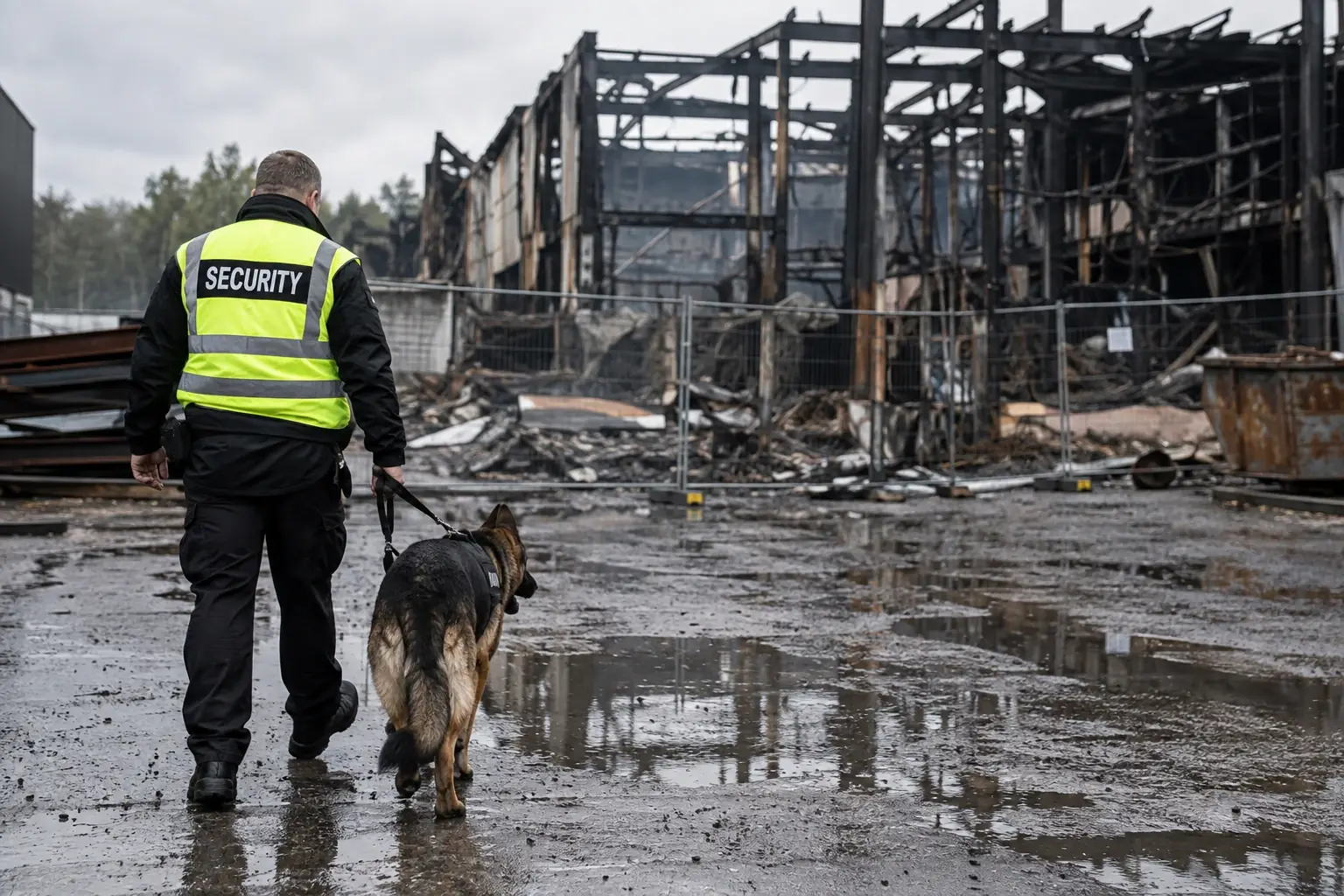


The building was completely destroyed and left at risk of collapse. A 200 metre cordon was established, residents in the surrounding area were evacuated, and Clothier Road, Broomhill Road, Emery Road and Bonville Road were closed. No injuries were reported. The fire service said the blaze was possibly started deliberately, with the investigation continuing.
The detail that matters for industrial site security is not the size of the response. It is that the unit was empty. An occupied building of the same construction, on the same estate, would have had people in it who noticed the first minute of the fire rather than the tenth.
Industrial site security law: three duties owners routinely get wrong
Vacant industrial property sits at the intersection of three separate legal regimes, and in each one the position is less favourable to the owner than most assume.
Is squatting in an industrial unit a criminal offence?
No. Section 144 of the Legal Aid, Sentencing and Punishment of Offenders Act 2012 criminalised squatting only where a person is trespassing in a residential building and is living there or intends to. A building is residential for that purpose only if it was “designed or adapted, before the time of entry, for use as a place to live”. A warehouse, workshop or factory is not. Removing occupiers from a commercial building is therefore a civil possession action through the courts, with the delay and cost that implies. This is the single most common misunderstanding in industrial site security, and it is usually discovered at the worst possible moment.
Read section 144Who is responsible for fire safety in an empty unit?
The owner, in most void cases. Article 3 of the Regulatory Reform (Fire Safety) Order 2005 makes the responsible person whoever has control of the premises in connection with carrying on a trade or business — and where there is no such person, “the owner”. When a tenant vacates, the duty does not lapse with the lease. It moves up to the landlord.
Read article 3Who pays to clear waste tipped into an empty building?
Potentially the occupier. Section 59 of the Environmental Protection Act 1990 allows an authority to require waste to be removed within a period of not less than twenty-one days, where it is satisfied the occupier deposited it or “knowingly caused or knowingly permitted” the deposit. Failure to comply without reasonable excuse carries a fine, and the authority may remove the waste itself and recover its reasonable expenses. The words to weigh are “knowingly permitted”: a site the owner knows is being used for dumping, and leaves open, is a harder position to defend than one that is secured and monitored.
Read section 59Does the Health and Safety at Work Act reach an empty site?
Section 3 requires an employer to conduct their undertaking so that people who are not employees are not exposed to risks to their health or safety, and section 37 extends liability to directors and managers. Holding and managing industrial property is an undertaking. An unsecured building with damaged asbestos, open pits or unstable structure is a risk to whoever gets into it.
Must industrial site security officers be SIA licensed?
Yes. The Private Security Industry Act 2001 requires officers supplying contract manned guarding to hold a valid SIA licence for the activity performed. Every AGS officer is SIA licensed.
What industrial site security is actually protecting
The inventory of a void industrial building is deceptive. It looks empty. It is not.
- Copper and cable. Distribution boards, sub-mains, lighting circuits and any remaining plant wiring. Stripping it usually means cutting the building about, so the repair exceeds the scrap value many times over.
- Structural and architectural metal. Roof sheeting, purlins, cladding rails, handrail, grating and gates. Removal opens the building to weather and to entry.
- Mechanical plant. Compressors, chillers, air handling units, transformers and lift gear left in situ between tenancies.
- Fire protection systems. Sprinkler pipework and valve sets are copper and steel to a thief, and their loss removes the one system that might have contained a fire.
- The building as a venue. Unauthorised events, off-road riding, and filming generate their own fire and injury exposure.
- The building as a tip. Waste dumped inside is both a clearance bill and a fire load, and mixed waste of unknown origin is expensive to characterise before it can be moved.
Industrial site security on a void asset is therefore not guarding stock. It is preventing the building from being converted, piece by piece, into someone else's income and your liability.
Which industrial site security services suit a part-let estate?
Proportionality is the whole discipline here. A fully manned void unit is rarely justifiable; an unwatched one is rarely defensible. These are the arrangements AGS Security deploys on industrial sites and across warehousing and logistics property.
Vacant property security
The core service for a void unit: sealing the building, controlling the single point of entry, and inspecting the interior rather than only the perimeter, because most of the damage happens inside.
Mobile patrols across the estate
The proportionate answer for multiple voids. Randomised visits with GPS-logged attendance and a written report per unit, covering all of them in one circuit rather than staffing each.
Gatehouse and HGV access control
On occupied manufacturing and distribution sites, the gate is where loss is prevented or recorded. Driver verification and a delivery log turn a dispute into a document.
Static guarding during works
Strip-out, refurbishment and demolition put the building at its most exposed — open, full of hot works, and with material worth taking already loosened.
K9 handlers
Effective on large footprints and after an incident, where a damaged building must be held secure but is not safe to occupy conventionally.
Fire watch and alarm response
Where fire systems are impaired, isolated or stripped, a fire watch is often the condition on which cover continues. Key holding puts out-of-hours attendance with us.
Industrial site security records, insurers and proving what you did
Void property is written on conditions. Inspection frequency, isolation of services, removal of combustible waste and securing of openings are commonly required, and the question after a loss is not whether the schedule said so but whether it happened.
That is a documentation problem as much as a security one. Time-stamped patrol reports, photographs of each visit and a dated record of what was found convert a set of intentions into evidence. Without them an owner is asserting compliance and producing nothing.
The same record answers the regulator. It shows when the building was last inspected under the Fire Safety Order, and it shows the authority that dumping was neither known about nor permitted — which is precisely the test in section 59.

Industrial site security checklist for a vacant unit
Worth running the day a tenant vacates rather than the day a letting is agreed. Industrial site security decisions taken at handover cost a fraction of those taken after an incident.
- Is the building sealed at every opening, including roof lights, service risers and the yard gate that has never locked properly?
- Have services been isolated, and is the electrical supply dead or still live to a distribution board somebody may strip?
- Has combustible waste been removed from inside, rather than swept into a corner for the next occupier?
- Is the fire alarm or sprinkler system live, impaired or gone, and does the insurer know which?
- Who is the responsible person under the Fire Safety Order now the tenant has gone, and have they been told they are?
- Is anyone inspecting the interior, or only driving past the front elevation?
- Is there a dated, photographed record of each inspection?
- If occupiers entered tomorrow, who instructs the possession proceedings and how long would they take?
- Does the insurer's void condition set an inspection interval, and is it actually being met?
AGS covers industrial estates nationally, with regional detail for the West Midlands, South Midlands, East Midlands and East of England, and the full list on the locations page.
Industrial site security: frequently asked questions
Is squatting in a commercial or industrial building illegal?
It is not a criminal offence in itself. Section 144 of LASPO 2012 applies only to residential buildings, defined as designed or adapted before entry for use as a place to live. Recovering a commercial building from trespassers is a civil possession action.
Who is the responsible person for fire safety in a vacant industrial unit?
Article 3 of the Regulatory Reform (Fire Safety) Order 2005 makes it the person with control of the premises in connection with a trade or business, and where there is none, the owner. In a void unit that is normally the landlord.
Who has to clear fly-tipped waste from an empty building?
Under section 59 of the Environmental Protection Act 1990 an authority can require the occupier to remove it within not less than twenty-one days where satisfied they deposited it or knowingly caused or permitted the deposit, and can remove it and recover reasonable expenses if that is not done.
How many building fires are there in England each year?
Fire and rescue services attended 14,167 fires in buildings other than dwellings in the year ending September 2025, an increase of 7.8% on the previous year, according to Home Office statistics published in January 2026.
What is the most cost-effective industrial site security for several empty units?
Usually randomised mobile patrols with logged attendance and interior inspection across the whole estate, escalating to static or K9 cover on any unit that has already been targeted, rather than staffing each unit separately.
Which areas does AGS Security cover?
AGS Security covers sites across England, Scotland and Wales from its base in Wolverhampton, West Midlands, providing manned guarding, gatehouse security, mobile patrols, K9 dog handlers, CCTV monitoring, key holding and alarm response.
Contact AGS Security for industrial site security
Tell us how many units are void, what condition they are in and how long they are likely to stay empty, and we will set out what the industrial site security arrangement should be. Assessments are carried out without charge or obligation.
Creative Industries Centre, Glaisher Drive, Wolverhampton, West Midlands, WV10 9TG
England, Scotland and Wales — check your area
About the publisher. AGS Security is the trading name of Albrighton Group Services Ltd, a security contractor registered in England and Wales, company number 13057321, registered with the Information Commissioner's Office under registration ZB329521.
The company provides manned guarding, gatehouse security, mobile patrols, K9 dog handling, CCTV monitoring, key holding and alarm response to construction, residential development, civil engineering, utilities and energy, industrial, warehousing and commercial property clients across England, Scotland and Wales. Head office: Creative Industries Centre, Glaisher Drive, Wolverhampton, West Midlands, WV10 9TG. Telephone 0333 577 1777.
Arrange an industrial site security assessment
A short industrial site security visit establishes how the building is actually getting entered, what remains inside worth taking, and what level of cover is proportionate to the void period. No obligation and no charge.
This article is general information about industrial site security and the duties applying to commercial and industrial property in Great Britain. It is not legal advice, and it is not advice on the terms of any policy of insurance.
Sources: building fire figures are Home Office fire and rescue incident statistics for the year ending September 2025, published 29 January 2026; the Bristol incident is reported from ITV News West Country coverage of 1 and 2 September 2026 and statements attributed to the fire service; the squatting position is section 144 of the Legal Aid, Sentencing and Punishment of Offenders Act 2012; the fire safety duty is article 3 of the Regulatory Reform (Fire Safety) Order 2005; the waste removal power is section 59 of the Environmental Protection Act 1990.
Duties under the Regulatory Reform (Fire Safety) Order 2005, the Environmental Protection Act 1990, the Health and Safety at Work etc. Act 1974 and the Private Security Industry Act 2001, and the terms of any void property insurance, should be considered with your own legal, insurance and health and safety advisers.