Security Dog Handlers: Professional K9 Protection for Construction Sites
Security Dog Handlers for Construction Sites
Security dog handlers provide one of the strongest visible deterrents available for construction sites, infrastructure projects, industrial premises and other higher-risk environments.
Construction sites contain valuable plant, fuel, cable, tools, machinery and building materials. They also contain incomplete structures, scaffolding, excavations and temporary installations that can pose serious risks to anyone entering without authorisation.
CCTV, alarms and perimeter fencing are important security measures, but they do not always provide an immediate physical response. A professionally trained security dog and handler team combines the judgement of an experienced security officer with the heightened senses, mobility and deterrent value of a trained patrol dog.
This guide explains how security dog handlers protect UK construction sites, why SIA licensing and recognised dog-handler training matter, how dog welfare and continual training support compliance, and what construction companies should examine when appointing a K9 security provider.
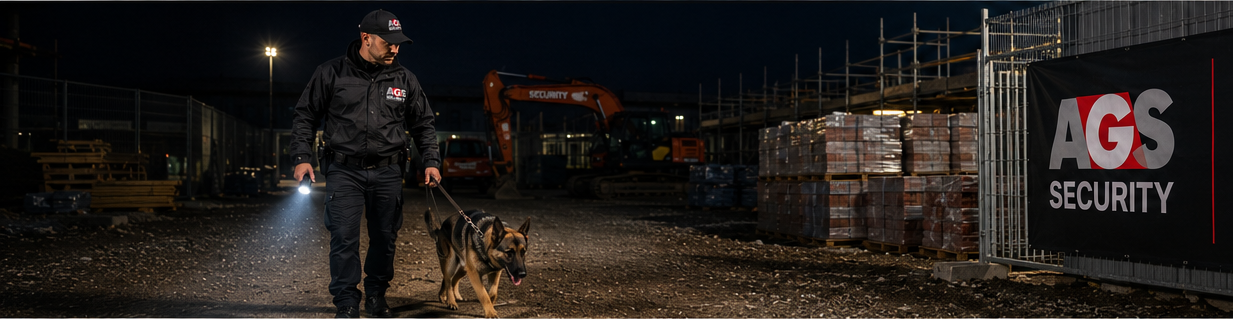
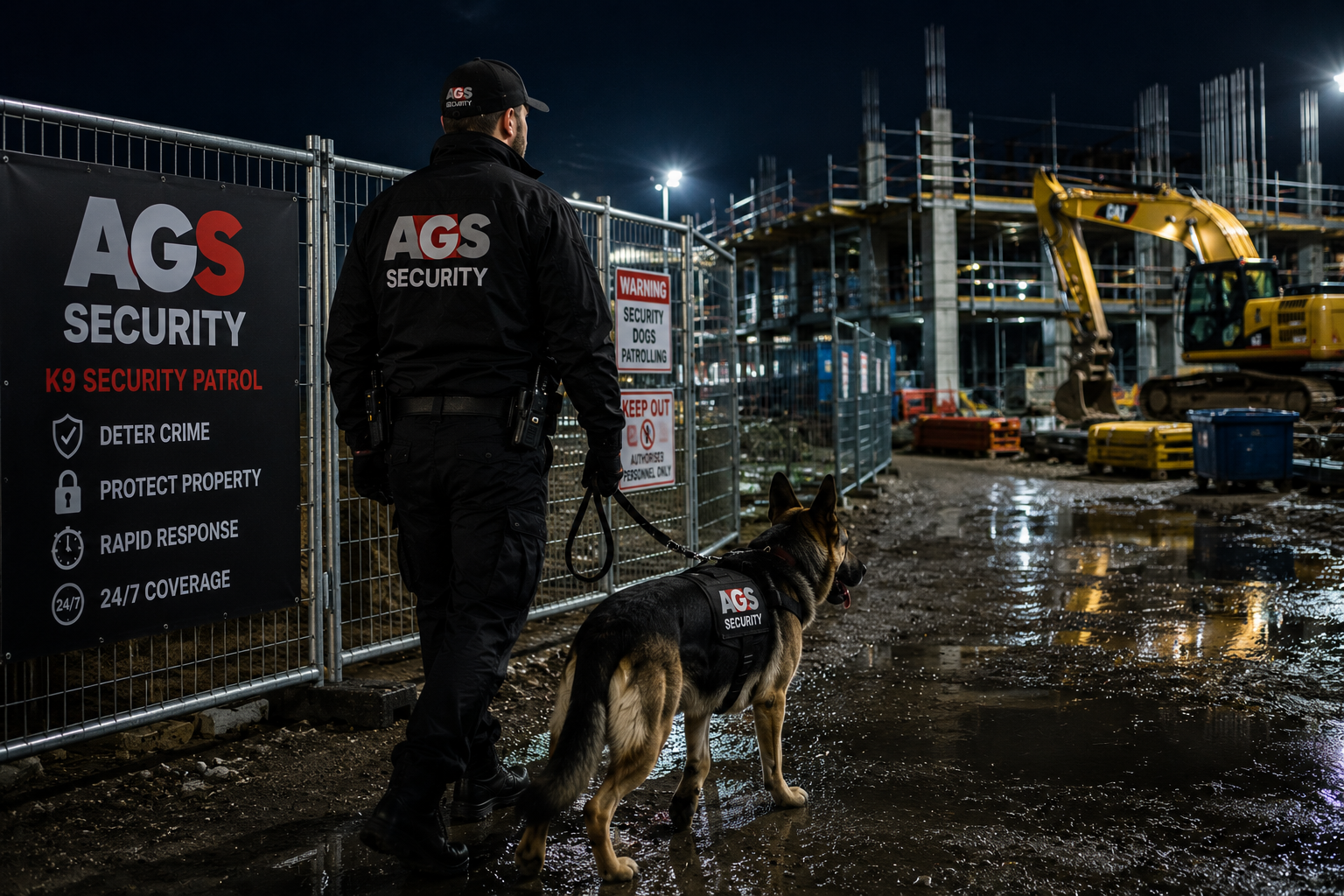
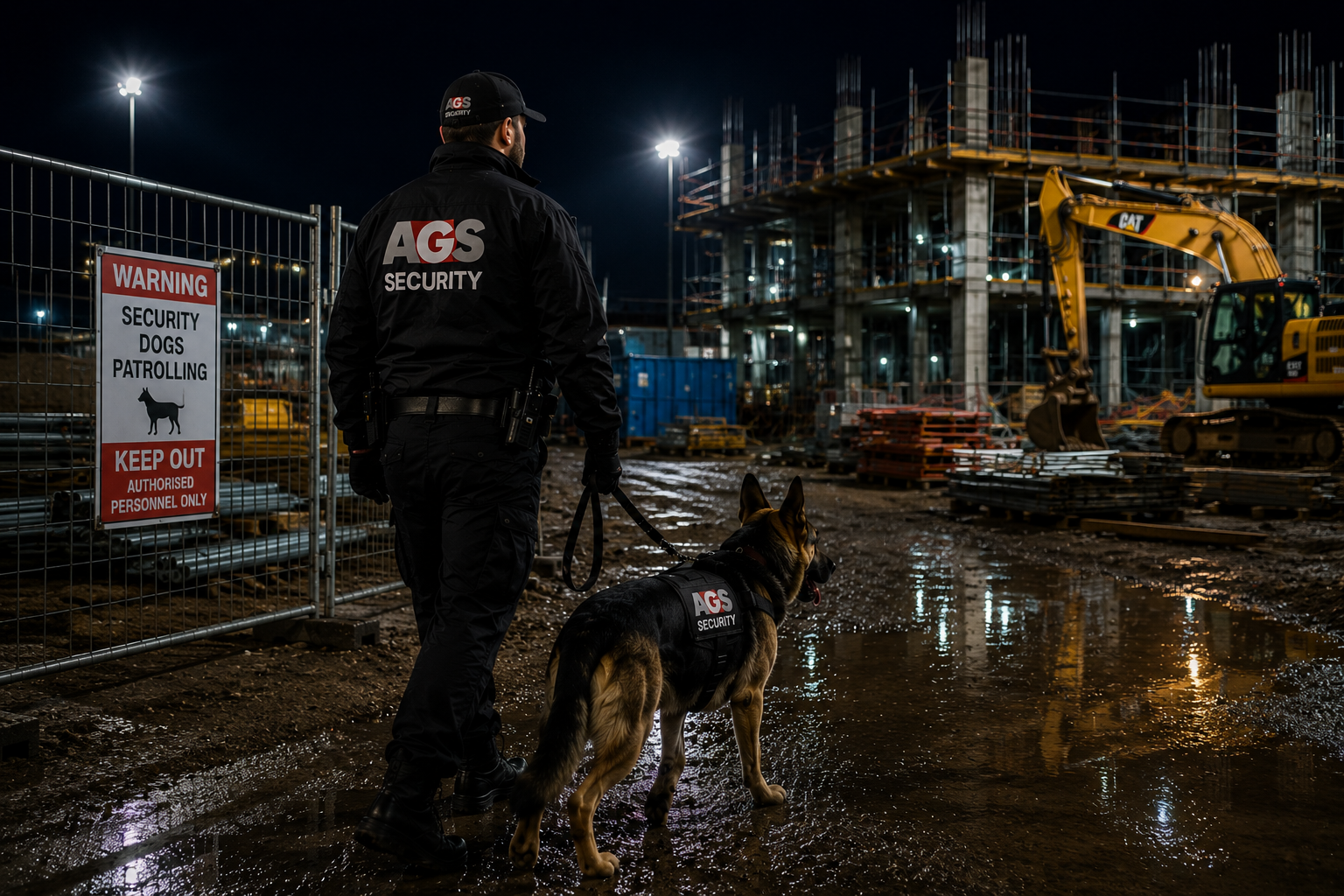
A professionally trained security dog and handler team provides visible deterrence, patrol capability and rapid incident response.
A security dog handler is a trained security operative who works in partnership with a suitable patrol dog to protect people, premises and assets.
The handler remains responsible for assessing risks, controlling the dog, following assignment instructions and responding proportionately to incidents. The dog provides additional deterrence, heightened awareness and an enhanced ability to search large or difficult areas.
A K9 team should not be viewed as simply a security officer accompanied by a dog. The handler and dog must operate as a controlled, trained and regularly assessed working partnership.
A security dog team should demonstrate:
Appropriate SIA licensing for the guarding activity performed
Recognised security dog-handler training
Effective control and obedience
Safe and proportionate deployment
Current operational training records
Suitable insurance protection
Incident and patrol reporting
Documented dog welfare and transport arrangements
Major Security Risks on Construction Sites
Building sites are attractive to criminals because valuable items are often distributed across a large, changing environment. Work may stop overnight while machinery, materials and partially completed structures remain exposed.
Theft of plant and machinery
Excavators, generators, telehandlers, compressors and access equipment can carry significant replacement values. Theft can also cause project delays, hire charges and disruption to subcontractors.
Theft of tools and building materials
Power tools, copper, cable, fuel, appliances, sanitaryware and finishing materials may be targeted by opportunistic or organised thieves.
Trespass and unauthorised access
Trespassers may enter to steal, cause damage, explore or seek shelter. Children and members of the public may not appreciate the dangers associated with excavations, scaffolding, temporary electrics and incomplete structures.
Vandalism and deliberate damage
Damaged plots, broken windows, discharged fire extinguishers, graffiti and interference with plant or utilities can result in substantial costs and programme delays.
Arson and fire
Timber, packaging, fuel, gas cylinders and other combustible materials may increase fire risk. Sites experiencing repeated trespass or vandalism may require enhanced out-of-hours protection.
Occupation of completed or vacant plots
Show homes, sales offices, welfare units and completed but unoccupied properties may be vulnerable to break-ins, theft, vandalism or unlawful occupation.
Construction risk
Potential impact
K9 security support
Plant theft
Financial loss, downtime and replacement delays
Visible patrols, compound inspections and rapid area searches
Trespass
Injury, public-safety exposure and disruption
Perimeter patrols, detection and controlled intervention
Vandalism
Repair costs and programme delays
Strong visual deterrence and unpredictable patrol patterns
Arson
Fire, property destruction and serious safety consequences
Out-of-hours presence, early detection and escalation
Material theft
Replacement costs and supply-chain interruption
Storage-area patrols and suspicious-activity reporting
Benefits of Security Dogs on Construction Sites
Security dogs can provide significant benefits where a conventional guarding presence alone may not be sufficient.
Key operational benefits
Powerful visual deterrence: Potential intruders may be less willing to enter a site protected by a trained dog team.
Heightened detection: Dogs can alert handlers to movement, sounds and scent that may not be immediately apparent.
Large-area patrol capability: K9 teams are suitable for compounds, partially developed plots and extensive perimeters.
Rapid searches: A trained team can support methodical searches of buildings, boundaries and storage areas.
Enhanced officer confidence: The dog provides additional support in isolated and higher-risk environments.
Flexible deployment: Teams can support nights, weekends, shutdowns and higher-risk project phases.
Layered protection: Dog patrols can complement CCTV, alarms, fencing, lighting and mobile supervision.
How K9 Security Teams Deter Criminal Activity
The deterrent value of a patrol dog is both visual and audible. The presence of a controlled dog team can make a protected site appear significantly more difficult to enter or target.
Unlike fixed security systems, a dog team can move between entrances, compounds, plots, storage areas and perimeter boundaries. Patrol routes and timings can also be varied to reduce predictability.
Perimeter patrols
The handler can inspect fences, gates, hoarding, scaffolding access points and other vulnerable boundaries while the dog supports awareness of movement or hidden persons.
Building and plot searches
Where authorised by assignment instructions and safe to do so, the team may inspect partially completed buildings, site cabins, compounds or other areas following suspicious activity.
Response to suspected intrusion
The handler assesses the circumstances, maintains control of the dog, communicates with the control room and follows agreed escalation procedures. This may include contacting site management or the police.
K9 patrols can support perimeter security, area searches and out-of-hours incident response.
SIA Licensing for Security Dog Handlers
The Security Industry Authority does not issue a separate licence called a “dog-handler licence”. However, a dog handler performing licensable private-security work must hold the relevant front-line SIA licence for the activity being undertaken.
For example, a handler carrying out security guarding duties under a contract for services would normally need the appropriate security guarding or door supervision licence, depending on the actual duties.
Why SIA licensing matters
It supports legal deployment in licensable security roles.
Applicants are subject to identity and criminal-record checks.
The licence confirms completion of relevant licence-linked training.
Licence details can be checked through the SIA register.
Licence holders must follow the conditions attached to their licence.
NASDU Qualifications and Recognised Dog-Handling Standards
NASDU is the National Association of Security Dog Users. It promotes training and professional standards within the private security dog sector.
NASDU dog-handler programmes include nationally recognised qualifications designed to provide handlers with the skills, knowledge and understanding needed to work professionally with patrol dogs.
Relevant programmes are designed around National Occupational Standards and the training requirements associated with BS 8517-1 for general-purpose security dogs.
Areas commonly covered during dog-handler training
Dog handling and effective control
Obedience and responsiveness
Patrol procedures
Search techniques
Threat and risk assessment
Safe deployment around people
Relevant legislation and professional responsibilities
Dog welfare and operational care
Incident management and reporting
Working as an effective dog-and-handler team
Important: SIA licensing and NASDU training are different. An SIA licence relates to the licensable security activity. NASDU training provides role-specific security dog-handling competence.
Continuous Training and Operational Assessment
Initial qualification alone should not be treated as sufficient for the entire working life of a security dog team. Skills, obedience, control and operational readiness should be maintained through structured ongoing training.
Ongoing training may include:
Obedience and control exercises
Perimeter and building searches
Night-time patrol scenarios
Working around vehicles, machinery and construction noise
Safe interaction around authorised workers and visitors
Emergency recall and controlled withdrawal
Scenario-based incident response
Handler communication and decision-making
Dog welfare and first-aid awareness
Refresher training following changes in performance or deployment requirements
Training should be recorded so that clients can be confident that the team’s competence is being actively maintained rather than assumed.
Dog Welfare and Operational Fitness
Animal welfare is central to K9 security. A dog that is tired, unwell, distressed or unsuitable for the environment cannot provide a safe and effective service.
Providers should maintain clear arrangements for veterinary care, exercise, rest, hydration, feeding, transport and accommodation.
Essential welfare considerations
Regular veterinary care and health monitoring
Current vaccinations and preventative treatment
Appropriate food and clean drinking water
Suitable rest periods during and between shifts
Safe, ventilated and appropriate transport
Protection from excessive heat, cold and hazardous conditions
Monitoring for injury, illness, fatigue or behavioural change
Suitable exercise and enrichment
Immediate removal from duty where welfare or fitness is in doubt
Site-specific risk assessments should consider sharp materials, exposed reinforcement, traffic routes, chemicals, excavations, noise, temporary structures and other hazards affecting both the handler and dog.
Vetting, Screening and Professional Conduct
Construction clients entrust security personnel with access to valuable sites, sensitive information, keys and incident details. Robust screening and verification are therefore essential.
A vetting process should consider:
Identity verification
Right-to-work checks
SIA licence validation
Employment-history checks
References and background screening
Relevant training certificates
Dog-handler qualification verification
Driving-licence checks where vehicles are used
Site induction and assignment training
Professional conduct and reporting expectations
Where applicable, screening may be conducted in line with recognised industry vetting practices such as BS 7858.
Security Dogs and Construction Health and Safety
Construction sites are dynamic workplaces. The presence of a security dog team must be integrated into the site’s wider health and safety arrangements.
The principal contractor remains responsible for managing construction risks and taking reasonable steps to prevent unauthorised access. Security dog handlers support these arrangements but do not replace competent site management.
Site controls should address:
Safe patrol routes for the handler and dog
Vehicle and plant movements
Excavations, floor openings and incomplete stairs
Scaffolding and work-at-height hazards
Temporary electrical systems
Hazardous substances and contaminated areas
Noise and activities that may affect the dog
Interaction with authorised workers and visitors
Emergency evacuation arrangements
Areas where dog access is prohibited or inappropriate
Guard-dog warning signs and control
Guard-dog deployment must be managed in accordance with applicable law, including requirements relating to control and warning notices. Site-specific legal and operational advice should be obtained where necessary.
Insurance and £10 Million Liability Cover
Construction companies should verify that any appointed security provider holds appropriate insurance for the services being delivered, including the deployment of security dogs.
AGS Security maintains liability insurance cover up to £10 million, subject to the terms, conditions and current certificates applying to the relevant contract and activity.
Clients should request and verify:
Current public-liability insurance
Employers’ liability insurance
Specific confirmation that security dog activities are covered
Policy limits appropriate to the project
Any exclusions or special conditions
Vehicle insurance where patrol or response vehicles are used
Evidence of renewal when policies expire during the contract
Insurance does not replace effective risk management. The provider should also demonstrate training, supervision, safe systems of work and suitable dog-control procedures.
How to Choose a K9 Security Provider
Construction companies should look beyond the hourly rate and assess whether the provider can demonstrate competence, operational support and documentary compliance.
Questions to ask before appointing a provider
Does the handler hold the appropriate SIA licence?
What dog-handler qualification does the team hold?
Can current certificates be provided?
How frequently is continuation training completed?
How is dog welfare monitored?
What insurance cover applies to K9 operations?
How are patrols and attendance verified?
What incident-reporting system is used?
Who supervises and supports the handler?
Can replacement K9 teams be provided when required?
Does the provider understand construction-site risks?
Can the provider support individual and multi-site contracts?
Why Choose AGS Security Dog Handlers?
AGS Security provides security dog-handler services for construction sites, commercial premises, vacant properties, infrastructure projects and industrial environments across the UK.
Our K9 solutions can be deployed as a standalone service or integrated with manned guarding, mobile patrols, key holding, alarm response and CCTV-supported security arrangements.
AGS K9 service standards
Appropriately SIA-licensed security operatives
NASDU-qualified dog handlers available
Trained and controlled security dogs
Ongoing handler-and-dog training
Construction-site and commercial-security experience
Vetted and uniformed personnel
Site-specific assignment instructions
Regular patrol and incident reporting
Operational supervision and 24/7 support
Nationwide deployment capability
Flexible short-term and long-term cover
Liability insurance cover up to £10 million, subject to applicable policy terms
Frequently Asked Questions
Are security dog handlers suitable for construction sites?
Yes. Trained dog teams can provide strong deterrence, perimeter patrols, area searches and incident response on building sites, compounds and partially completed developments.
Does a security dog handler need an SIA licence?
The SIA does not issue a separate dog-handler licence. However, handlers carrying out licensable private-security duties generally require the relevant SIA licence for the work being performed.
What does NASDU qualified mean?
It means the handler has completed a relevant security dog-handling programme developed by NASDU and delivered through an approved training route. The exact qualification level and discipline should be verified.
Are security dogs trained continuously?
Teams should complete ongoing training to maintain obedience, control, search capability, fitness and operational competence. Training records should be retained and available for review.
Can a security dog work around construction workers?
Yes, provided the deployment has been properly assessed and controlled. The handler must maintain control and follow site-specific instructions covering authorised personnel, access routes and restricted areas.
Can K9 security be combined with other services?
Yes. Security dogs can form part of a layered solution including manned guarding, mobile patrols, CCTV, key holding and alarm response.
Does AGS Security provide nationwide K9 cover?
AGS Security supports planned and urgent dog-handler requirements across the UK, subject to location, site requirements and operational availability.
Does AGS have £10 million insurance cover?
AGS Security maintains liability insurance cover up to £10 million, subject to the current policy certificates, contractual scope, exclusions and applicable terms. Copies of relevant certificates can be provided during supplier onboarding.
Final Thoughts
Security dog handlers remain one of the most effective physical-security options for construction sites and other higher-risk premises.
Their value lies not only in the presence of the dog, but in the combined capability of a trained, controlled and professionally managed handler-and-dog team.
When supported by appropriate SIA licensing, recognised dog-handler qualifications, continual training, robust vetting, suitable insurance and high welfare standards, K9 security can help deter theft, prevent trespass, protect valuable assets and support wider construction-site safety arrangements.
Need Security Dog Handlers?
Speak to AGS Security about K9 protection for construction sites, infrastructure projects, commercial premises, industrial facilities and vacant properties.
To provide the best experiences, we use technologies like cookies to store and/or access device information. Consenting to these technologies will allow us to process data such as browsing behavior or unique IDs on this site. Not consenting or withdrawing consent, may adversely affect certain features and functions.
Functional
Always active
The technical storage or access is strictly necessary for the legitimate purpose of enabling the use of a specific service explicitly requested by the subscriber or user, or for the sole purpose of carrying out the transmission of a communication over an electronic communications network.
Preferences
The technical storage or access is necessary for the legitimate purpose of storing preferences that are not requested by the subscriber or user.
Statistics
The technical storage or access that is used exclusively for statistical purposes.The technical storage or access that is used exclusively for anonymous statistical purposes. Without a subpoena, voluntary compliance on the part of your Internet Service Provider, or additional records from a third party, information stored or retrieved for this purpose alone cannot usually be used to identify you.
Marketing
The technical storage or access is required to create user profiles to send advertising, or to track the user on a website or across several websites for similar marketing purposes.