
How Businesses Across the West Midlands Can Reduce Security Risks
A practical guide for property, facilities and site managers — how to find the weak points, prioritise controls and keep security arrangements fit for purpose as sites change.
Why West Midlands Security Risks Differ From Site to Site
Commercial premises, industrial yards, warehouses, construction projects and temporarily vacant buildings do not face identical security risks. A busy distribution facility may struggle with vehicle access, while a construction compound is most exposed when contractors leave for the day. An unoccupied building has a different problem altogether: nobody discovers damage until days after it happens.
Across the West Midlands, organisations operate in a mix of dense urban centres, industrial estates, logistics corridors and developing residential areas. Managing West Midlands security risks therefore begins with understanding the property, its people and its operating patterns — not with a standard package of equipment or guarding hours.
Who this guide is for
- Facilities and property managers
- Property owners and managing agents
- Construction and project teams
- Operations and site directors
For an overview of regional security coverage, see AGS Security's West Midlands security services.
Reduce Security Risks by Starting With the Consequences
To reduce West Midlands security risks, start with consequences. Before deciding whether a site needs more lighting, access control, patrols or guarding, identify what a security incident could disrupt. Stolen stock and damaged equipment are the obvious concerns. Less obvious are unsafe working conditions, missed deliveries, halted building works, lost records and the management time an investigation consumes. Local crime data and neighbourhood updates published by West Midlands Police on police.uk can help show which risks are most relevant to your area.
What matters most?
Identify the people, assets, information and business processes that need protection.
How could someone get in?
Walk every pedestrian, vehicle and service entrance, including temporary openings.
When is it least supervised?
Shift handovers, nights, weekends, bank holidays and contractor changeovers.
How would you find out?
Check the real coverage of alarms, cameras, staff observations and scheduled inspections.
Who takes action?
Confirm who receives alerts, who can attend and who is authorised to make decisions.
Walk it twice
Combine a daytime walkthrough with a safe review of quieter hours. Record findings, assign owners and set re-check dates.
Example security risk register
| Area | Potential weakness | Business consequence | Existing control | Review action |
|---|---|---|---|---|
| Vehicle entrance | Access code shared too widely | Unauthorised vehicle entry | Keypad and gate | Change the code and restrict who receives it |
| External storage | Poor sightlines | Material or equipment loss | Fence and lighting | Review lighting and the inspection route |
| Vacant unit | Long gap between visits | Damage discovered late | Periodic checks | Confirm the inspection and escalation schedule |
| Loading bay | Unclear visitor handover | Tailgating or stock discrepancy | Staff supervision | Clarify the authorisation procedure |
Illustrative examples only. This table is not a formal site-specific risk assessment.
Look for Security Gaps Between Individual Controls
A property can have good equipment and still have weak overall security. A camera may cover the gate but not the footpath beside it. A strong fence may lead to an unsecured maintenance opening. An alarm may work perfectly while its contact list names someone who no longer manages the site.
Many West Midlands security risks sit in these gaps. Rather than inspecting each control in isolation, follow the route an unauthorised visitor could take from the public boundary to your most valuable assets, and look for the gaps and unclear responsibilities along the way.
Quick gap checks
- Do contractors share access credentials?
- Are temporary openings secured at the end of every shift?
- Are keys and passes recovered when people leave a project? See key holding.
- On shared sites, is it agreed who controls the boundary and who can authorise out-of-hours access?
Adapt Security to the Type and Lifecycle of the Premises
Construction and refurbishment sites
Exposure changes throughout a project: early work involves plant, fuel and loose materials; later phases bring installed systems, valuable fittings and finished interiors, and fence lines move as the build progresses. Review the plan after every major phase change, update patrol routes and site instructions when the layout changes, and keep subcontractor access clear. Where dog handling is being considered, see the AGS guide to security dog handlers on construction sites.
Construction site security →Warehouses and industrial operations
Focus on stock movements, loading bays, staff entrances, parking and shift changes. Ask whether access records and incident reports would let a manager reconstruct what happened after a discrepancy. Controls should support safe, efficient operations rather than create bottlenecks.
Gatehouse security →Offices and commercial premises
Shared entrances, reception arrangements, cleaners, maintenance contractors and out-of-hours alarm response all deserve attention. Establish who can admit visitors, who controls keys and who receives incident notifications when the premises are closed.
Alarm response →Vacant or temporarily closed properties
Empty buildings suffer from late discovery of incidents, vandalism and unauthorised access. Secure openings, keep inspection records and name someone who can authorise urgent action. Insurance policies may set conditions for vacant premises, so check the actual policy rather than relying on a generic inspection timetable.
Vacant property security →Identify the Overlooked High-Risk Security Periods
Timing matters as much as layout when assessing West Midlands security risks. A site is not necessarily most vulnerable at midnight. The weak point may be the gap between the last contractor leaving and the evening lock-up, the handover between shifts or the start of a holiday closure.
Prepare a simple weekly exposure map: mark opening hours, deliveries, staffing levels, known access points and the periods when no one clearly owns checking the premises. Revisit it as construction phases change, and around peak dispatch times and staffing changes in warehouses. Where those periods have no cover, mobile patrols can be timed to them.
Three scenarios: choose one
Scenario A — construction handover
A site completes a major phase on Friday afternoon. Temporary fencing has moved, several subcontractors still hold access credentials and valuable equipment remains on site.
Priority: confirm the new perimeter, recover or cancel unneeded credentials and update the weekend response plan.
Scenario B — warehouse shutdown
A logistics operation closes for a bank holiday. Normal loading stops, but delivery vehicles may still arrive.
Priority: establish who can approve access, verify alarm contacts and document how unexpected arrivals will be handled.
Scenario C — vacant commercial property
An office unit becomes empty between tenants. A weekly visit may not find damage quickly enough for its particular exposure.
Priority: review the building's condition, insurance requirements, access controls and escalation process.
These scenarios are hypothetical and do not describe AGS client assignments.
Connect Security Deterrence, Detection and Response
Deterrence
Discourages unauthorised activity through controlled boundaries, maintained lighting, clear access arrangements and an appropriate visible presence, such as security guards or security dog handlers.
Detection
Identifies suspicious or unusual activity through alarms, cameras, access logs, staff reports and scheduled checks. It is only as reliable as the coverage, maintenance and review behind it.
Response
Decides what happens next: who receives the report, how urgency is judged, when emergency services are called and how evidence and decisions are recorded.
Keep the layers proportionate to the West Midlands security risks each site actually faces. More cameras do not help if no one is responsible for reviewing alerts, and a physical presence cannot make up for unclear access permissions or missing escalation instructions.
Turn Security Incident Records Into Management Decisions
Security reports should help managers spot patterns, not just confirm that something happened.
A monthly review can highlight repeated access failures, recurring alarm activations, missed handovers or misunderstood site instructions. Record the corrective actions and check that they were actually completed. Keep personal information, such as photographs of people, only as long as it is needed, in line with the ICO's guidance on storage limitation. For multi-site organisations, consistent reporting categories make trends comparable, while local site instructions keep the differences that matter.
What a useful incident record holds
- Time and location
- Observed facts, kept separate from opinion
- Action taken and who was notified
- Relevant reference numbers
- Follow-up owner and due date
- Photographs or evidence, retained under your data protection policy
Beyond Physical Security: Operational Oversight and Accountability
Even a carefully designed security plan depends on consistent execution. Supervisors need to know who is assigned to a site, what activity has been recorded, which incidents need follow-up and whether instructions are being followed.
AGS Security uses GuardBoard, its own security operations platform, to coordinate assignments and record operational activity in a structured way: officers book on and off, complete hourly, welfare and patrol checks, and record incidents, while managers see who is on duty, which checks are late or missed and what needs follow-up.
Technology is not a substitute for competent security personnel or site-specific procedures. Its value lies in helping teams organise information, review activity and maintain accountability. The reporting arrangements for any assignment are agreed with the client to suit their requirements.
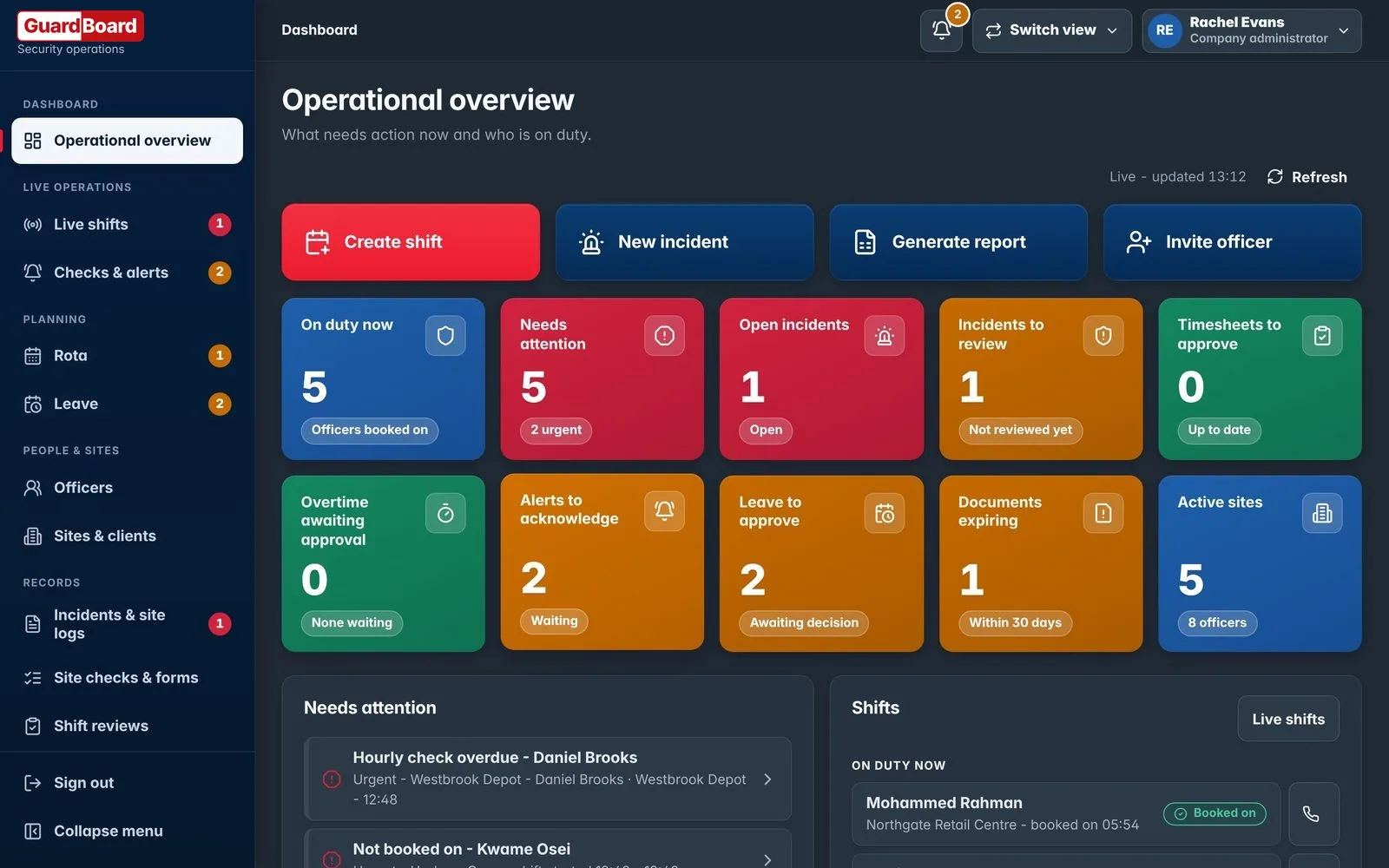
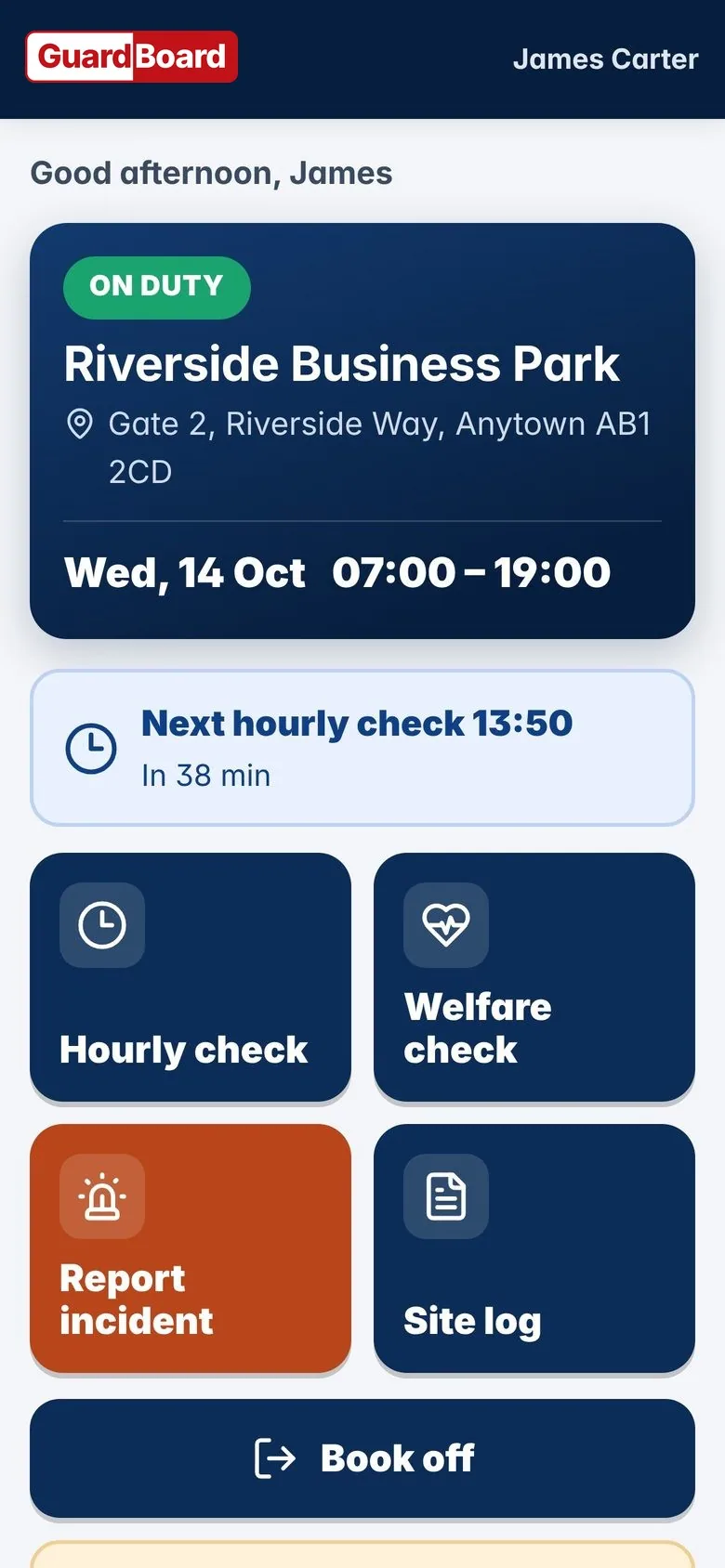
The GuardBoard manager dashboard and officer app.
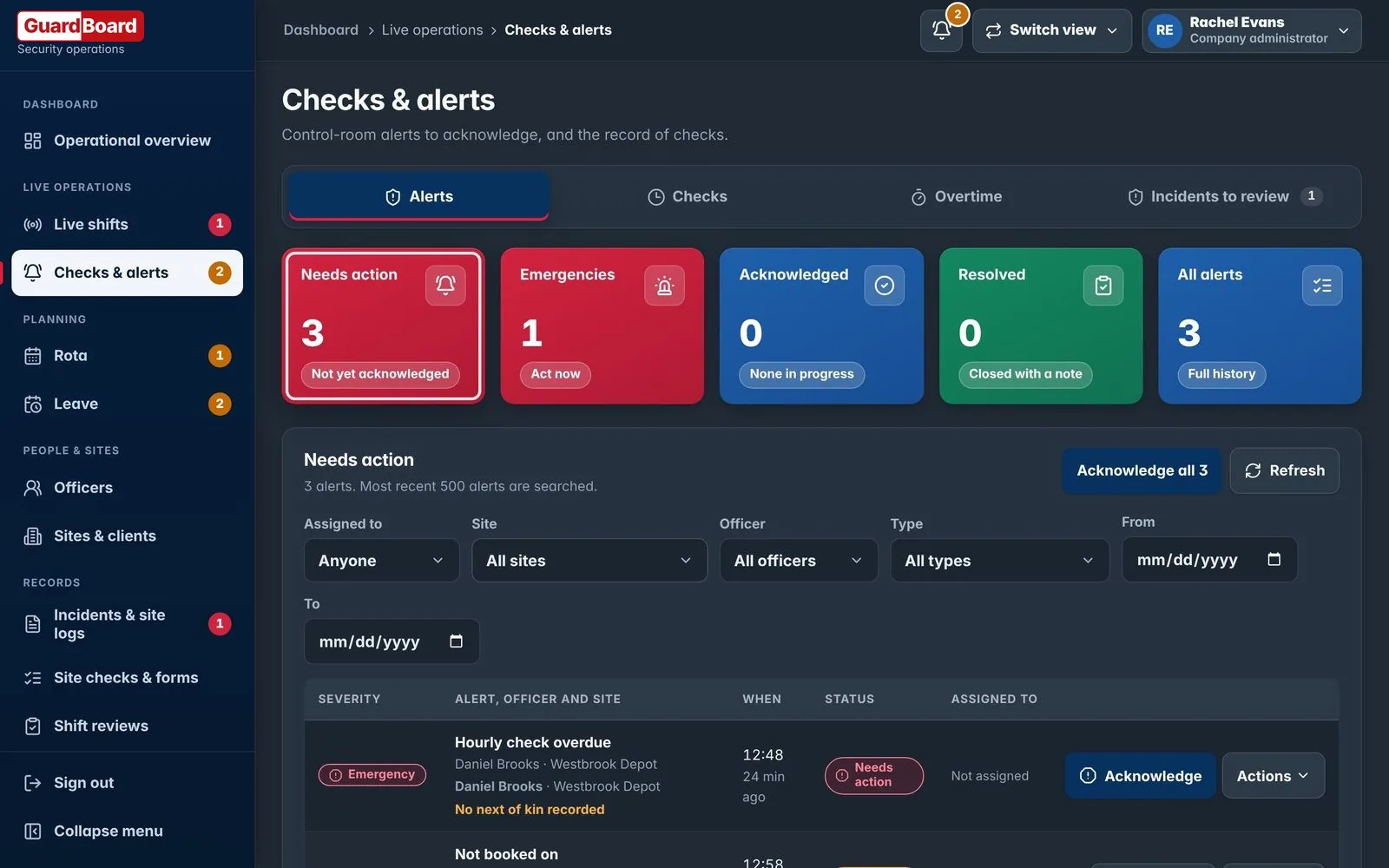
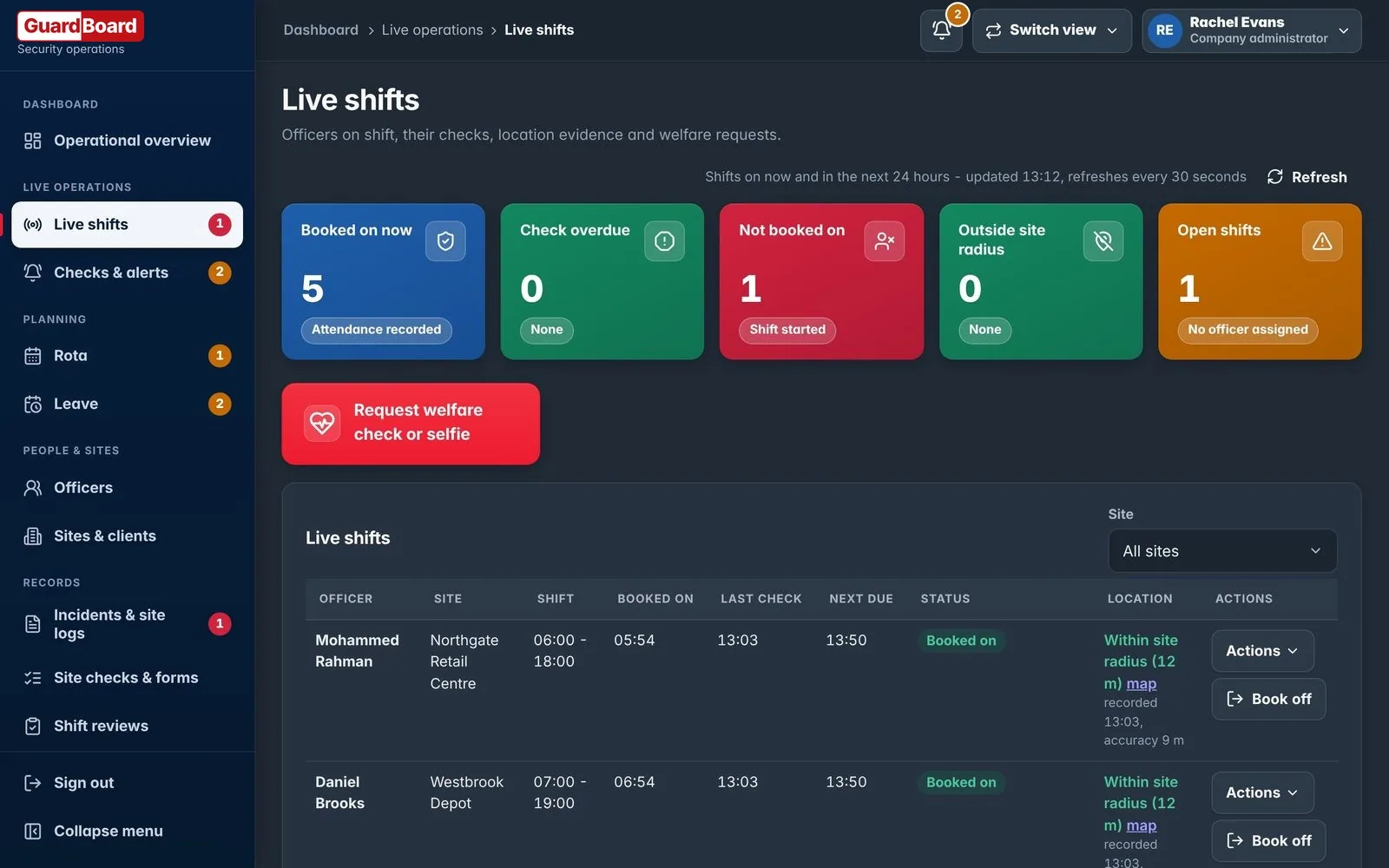
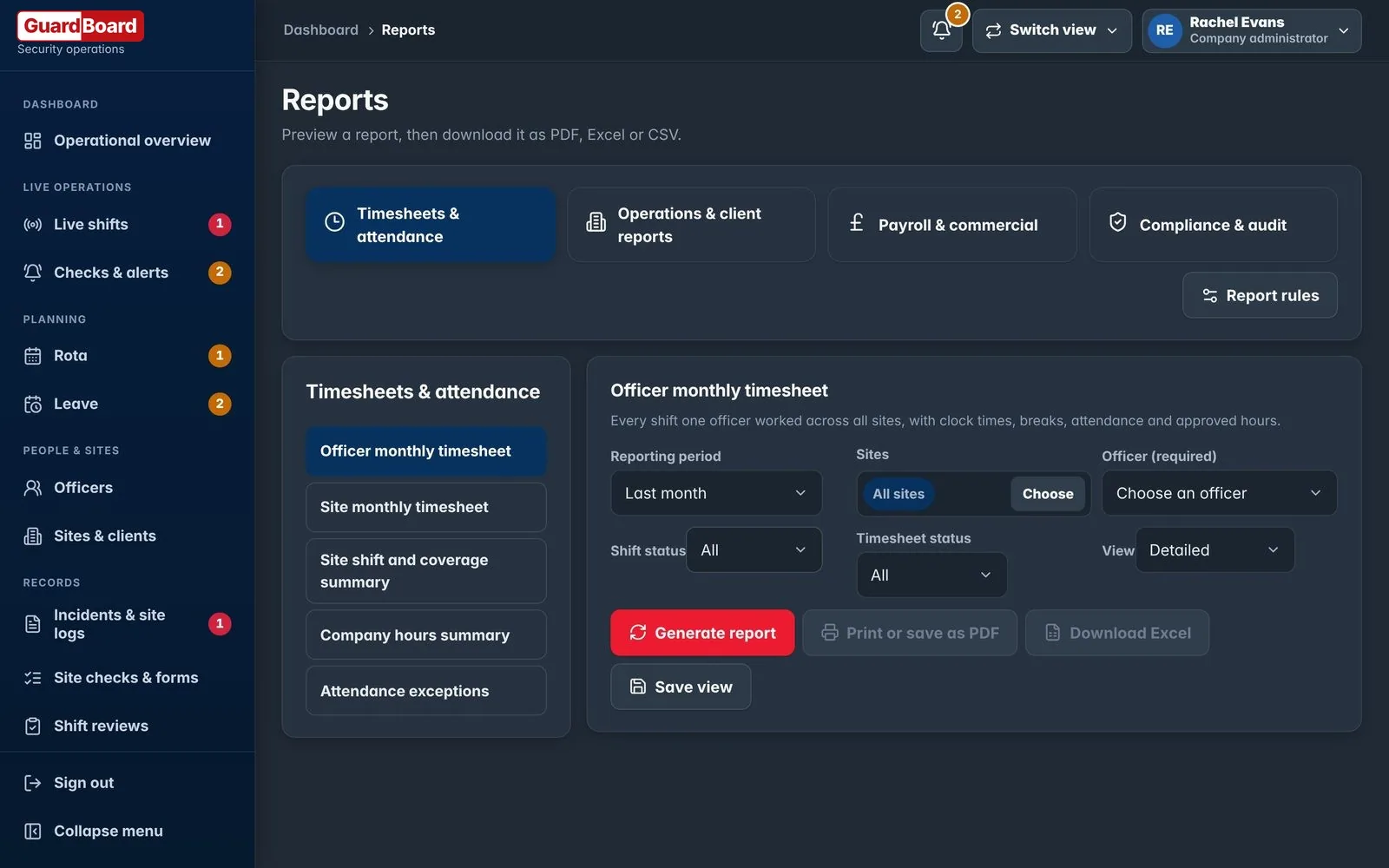
Screens show demonstration data, not real officers, sites or clients.
Apply Consistent Security Governance Across West Midlands Sites
Organisations with premises in Birmingham, Wolverhampton, Coventry, Walsall and across the Black Country benefit from consistent incident categories, escalation contacts and review procedures for West Midlands security risks. But each property still needs controls that reflect its own layout, operating hours and exposure.
A commercial office in Birmingham may need a different visitor process from an industrial yard in Walsall. A construction project in Coventry may need frequent perimeter reviews, while a vacant unit in Wolverhampton may need particular attention to inspections and key holding.
These location pages describe AGS service coverage; they are not claims of completed assignments in each area.
West Midlands Security Review Checklist
Use this checklist to review West Midlands security risks before the next management meeting or site handover. Tick off what you can confirm today, then print or save it for your records.
All ten confirmed. Book the next review date.
AGS Security · West Midlands Security Risk Review Checklist · www.albrighton-group.co.uk · 0333 577 1777
Security Risk Review: Frequently Asked Questions
How often should a business review its security risks?
Review security risks at planned intervals and whenever there is a material change in occupancy, access arrangements, building work or incident patterns. Fast-changing sites, such as construction projects, may need more frequent checks.
Can CCTV alone protect an industrial property?
CCTV can assist detection and evidence gathering, but its effectiveness depends on coverage, maintenance, monitoring and response. It should be considered alongside physical and procedural controls.
What should be checked before a holiday shutdown?
Confirm gates and doors are secured, contact details are current, access permissions are reviewed, vulnerable assets are protected and the response process is understood by everyone involved.
Should every site in a property portfolio use the same security plan?
Common governance standards are useful, but the practical controls should reflect each site's risks, layout, operating hours and assets.
Make Security Planning a Continuous Process
The strongest security arrangements are reviewed as sites change. Start with the West Midlands security risks that could cause the greatest disruption, close the gaps between existing controls and make sure someone owns every finding. Trained security personnel, clear procedures and structured operational oversight work best together as part of a proportionate approach. If you manage property or sites in the West Midlands and would like a second view of your arrangements, AGS Security can review a site with you and recommend proportionate options.
AGS Security Contact Details
- Telephone
- 0333 577 1777 (24/7)
- info@albrighton-group.co.uk
- Head office
- AGS Security, Science Park, Creative Industries Centre, Glaisher Drive, Wolverhampton WV10 9TG
- Website
- www.albrighton-group.co.uk
AGS Security — People. Property. Peace of Mind. AGS Security is the trading name of Albrighton Group Services Ltd, registered in England and Wales, company number 13057321, ICO registration ZB329521.
AGS provides security guards, construction site security, security dog handlers, gatehouse security, mobile patrols, key holding, alarm response and vacant property security across the West Midlands, England, Scotland and Wales.
This guide is general information about West Midlands security risks. It is not a formal site risk assessment, an interpretation of any insurance policy or a guarantee against loss. GuardBoard screenshots show demonstration data.